


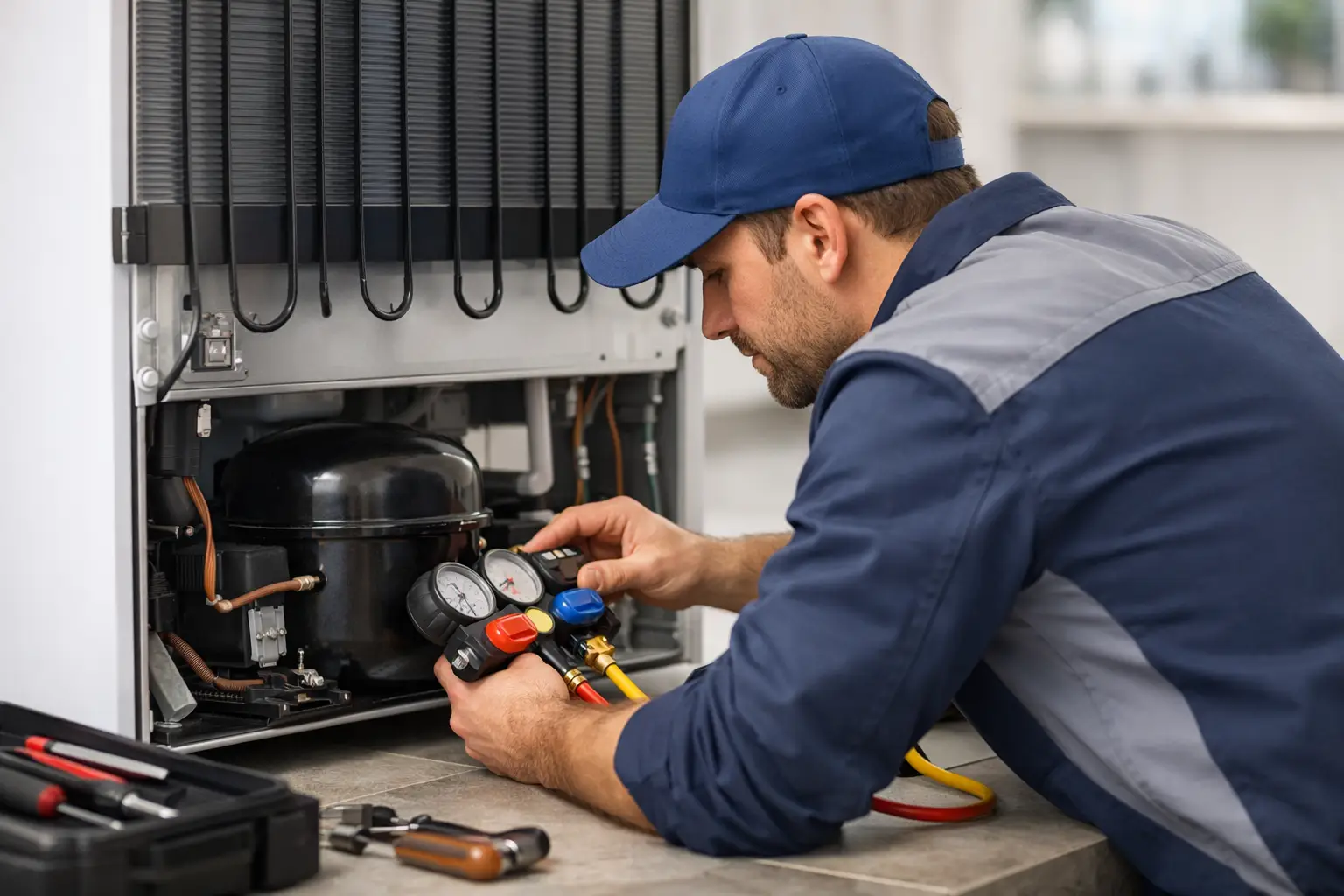
A refrigerator that clicks, hums, and then goes quiet is usually telling you something expensive may be developing. When people search for how to repair fridge compressor problems, they are often already dealing with warm food, melting freezer items, and a kitchen appliance that cannot wait a few days.
The hard truth is that true compressor repair is rarely a simple homeowner fix. In many cases, the compressor itself is not the failed part at all. The trouble may come from the start relay, overload protector, capacitor, thermostat, control board, condenser coils, or airflow restrictions that make the compressor seem bad when it is actually being prevented from running correctly. That distinction matters, because replacing a small electrical component is very different from replacing a sealed-system part.
What a fridge compressor actually does
The compressor is the heart of the refrigeration system. It pressurizes refrigerant and keeps it moving through the sealed system so your refrigerator can remove heat from the cabinet. If the compressor does not start, runs weakly, or shuts down repeatedly, cooling performance drops fast.
This is also why compressor problems get so much attention. A noisy fan or broken shelf is inconvenient. A compressor-related issue can put the entire refrigerator out of service.
Signs you may have a compressor problem
Not every warm refrigerator has a failed compressor, but some symptoms point in that direction. A fridge that is not cooling while the interior lights still work is one common sign. Repeated clicking every few minutes is another. You may also notice the compressor housing feels very hot, the unit trips the overload, or the refrigerator runs constantly without getting cold enough.
Sometimes the opposite happens. The refrigerator appears mostly normal, but the freezer softens first, ice cream gets slushy, and temperatures slowly rise over a day or two. That pattern can point to a compressor losing efficiency rather than stopping completely.
The challenge is that these symptoms overlap with several other failures. That is why accurate diagnosis comes first.
How to repair fridge compressor problems starts with diagnosis
If you want to understand how to repair fridge compressor issues the right way, start with the basic question: is the compressor bad, or is something else keeping it from running?
A technician usually checks whether the compressor is receiving power, whether the start components are functioning, and whether the compressor draws the correct amperage at startup. They also inspect condenser coils, condenser fan operation, evaporator frost pattern, and control inputs.
If the compressor tries to start and clicks off, the start relay or overload may be the problem. If it runs but cooling is still poor, the issue may be an inefficient compressor or a sealed-system restriction. If there is no attempt to start at all, the fault may be upstream in the controls rather than at the compressor.
That is why guessing can get expensive. Replacing parts based on symptoms alone often wastes time and money.
Problems that look like a bad compressor
Failed start relay or overload protector
This is one of the most common misdiagnosed issues. A failed start relay can keep the compressor from turning on, even though the compressor itself is still good. The refrigerator may make a clicking sound every few minutes as it tries and fails to start.
In this situation, repair may be straightforward if the correct part is installed and the compressor tests within range. It is a much smaller repair than compressor replacement.
Dirty condenser coils or a bad condenser fan
If heat cannot leave the system properly, the compressor works harder and hotter. Over time, that can cause poor cooling, short cycling, or overheating symptoms that mimic compressor failure. Cleaning coils or replacing a failed condenser fan motor can restore normal performance if caught early enough.
Thermostat or control board failure
Some refrigerators never send the proper signal for the compressor to run. Others may power it inconsistently. The result looks serious, but the sealed system may be fine.
Defrost system issues
A refrigerator with a heavy frost buildup can lose cooling and seem like it has a compressor problem. In reality, the compressor may be running while airflow is blocked by ice.
When a compressor can be repaired and when it must be replaced
This is where homeowners usually want a simple answer, but it depends on the exact failure.
If the issue is external to the compressor, such as a relay, overload, wiring connection, or capacitor, the refrigerator may be repairable without replacing the compressor. If the compressor has internal electrical failure, mechanical seizure, or weak pumping ability, repair of the compressor itself is generally not practical. In those cases, replacement is the normal solution.
Compressor replacement is a specialized job. It involves sealed-system work, refrigerant handling, brazing, evacuation, recharge, and precise testing. This is not routine DIY territory, and it is not something a general handyman should guess at.
There is also a cost question. On some refrigerators, especially older or lower-cost models, compressor replacement may not make financial sense compared with replacing the appliance. On newer, built-in, high-end, or premium-brand units, compressor replacement can be the smarter investment.
Can you fix a fridge compressor yourself?
For most homeowners, the safe answer is limited. You can check whether the refrigerator has power, confirm the temperature controls are set correctly, and make sure the condenser coils are not packed with dust. You can also listen for clicking, humming, or complete silence, because those details help with diagnosis.
Beyond that, compressor-related work should be handled professionally. Sealed-system repairs require specialized tools, training, and legal refrigerant handling procedures. There is also a safety issue. Compressors, relays, and capacitors involve live electrical components, and misdiagnosis can damage the board, wiring, or the replacement part itself.
If your goal is to protect the refrigerator and avoid repeat service, professional diagnosis is usually the fastest path.
How technicians test compressor health
Electrical testing
A technician may test compressor windings for continuity and resistance balance, inspect for shorts to ground, and verify startup components are operating correctly. This helps separate a failed compressor from a relay or power supply problem.
Amp draw and startup behavior
The way a compressor pulls current during startup says a lot. High locked-rotor amperage with repeated shutdown can point to internal compressor trouble. Low or inconsistent draw can suggest a control or component issue.
Cooling performance and sealed-system behavior
A compressor can run and still be bad. If it is no longer pumping refrigerant effectively, cabinet temperatures rise even though the unit sounds active. Technicians look at frost patterns, pressures, temperatures, and run times to determine whether the sealed system is doing its job.
Repair versus replacement depends on more than the compressor
A compressor diagnosis should never happen in a vacuum. Refrigerator age matters. Brand matters. Part availability matters. Warranty status matters too, because some manufacturers cover sealed-system components longer than standard parts.
Homeowners are often surprised to learn that a refrigerator with a compressor issue may still be worth fixing if the cabinet, doors, shelves, electronics, and overall condition are good. On the other hand, if the unit already has multiple aging components, replacement may be the better value.
That is why a trustworthy service company should explain both the technical problem and the cost trade-off, not just recommend the largest repair.
What to do if your fridge stops cooling now
First, avoid opening the doors more than necessary. Cold air escapes quickly, and every extra opening raises the internal temperature. If food safety is becoming a concern, move high-risk items to another working refrigerator or an ice-filled cooler.
Next, check for the basics. Make sure the breaker has not tripped, the outlet has power, and the temperature settings have not been changed accidentally. Listen near the back of the refrigerator. A repeated click, a brief hum, or complete silence are all useful clues.
If the compressor area is extremely hot, unplugging the refrigerator for a short period may allow an overheated overload protector to reset, but that is not a real fix. If the same symptom returns, the unit still needs diagnosis.
Why fast service matters with compressor-related issues
Compressor complaints tend to get worse, not better. A weak relay can fail completely. An overheating compressor can shut down more frequently. A sealed-system problem can leave you with a full refrigerator of spoiled groceries if you wait too long.
For busy households, speed matters as much as the repair itself. The sooner the problem is tested properly, the sooner you know whether you are dealing with a minor electrical component, a major sealed-system repair, or a refrigerator that is no longer worth investing in.
If your refrigerator is clicking, running hot, or no longer cooling in Irvine or Orange County, professional diagnosis can save time and prevent unnecessary part replacement. For fast local help, you can contact Prostar Appliance Service through our Google Business Profile and get a clear answer on the next step.