


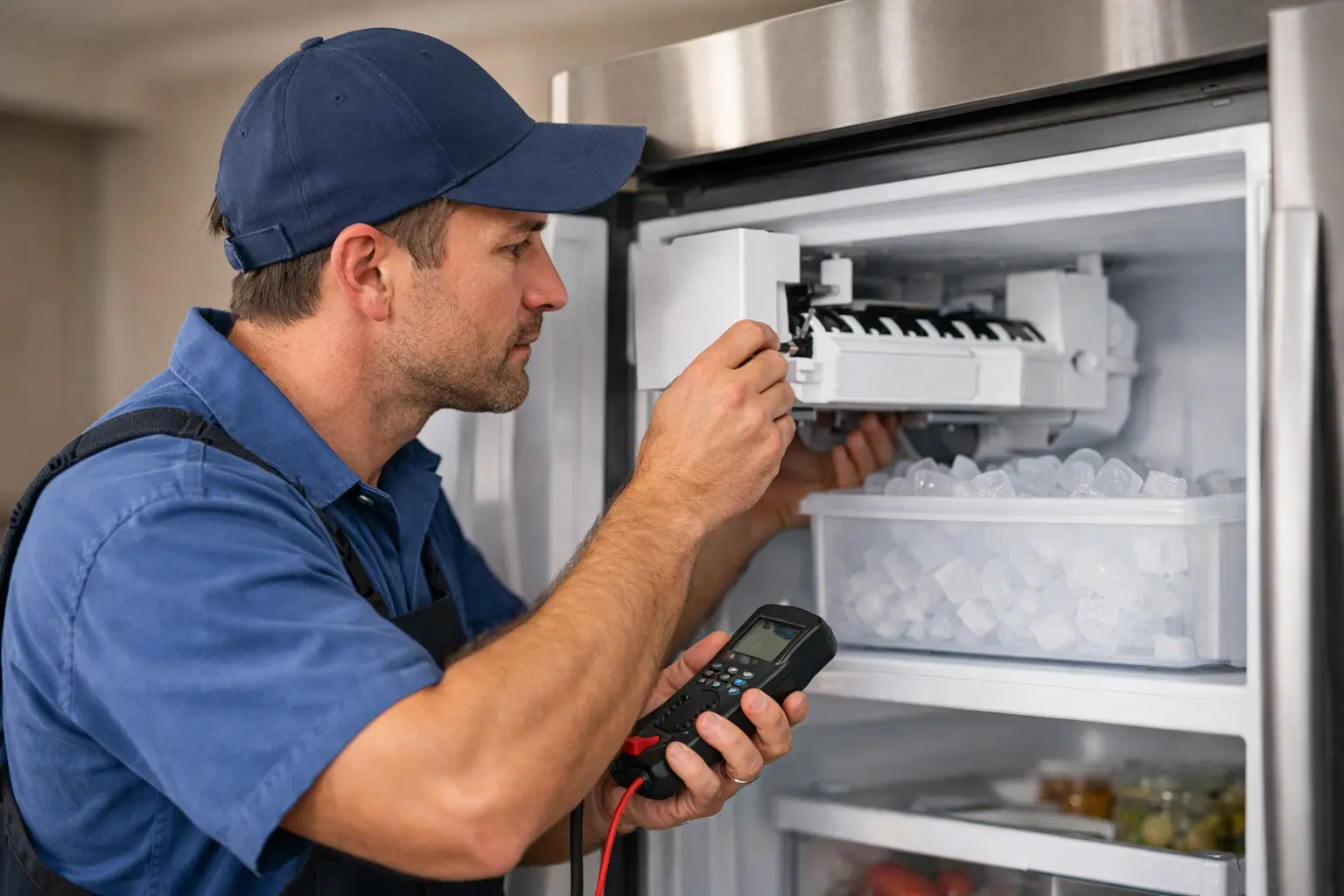
When the ice maker stops working, most homeowners notice it at the worst possible time – right before guests arrive, during a heat wave, or when the freezer is otherwise running fine and the problem makes no sense. If you are searching for how to repair refrigerator ice maker problems, the real goal is usually simpler: figure out whether this is a quick fix, a part failure, or a repair that needs a trained technician before food storage and daily use get disrupted.
An ice maker is a small system with several points of failure. Water supply, inlet valve, fill tube, shutoff arm, temperature, mold thermostat, motor module, and control board all have to work together. That is why the right repair starts with diagnosis, not guessing. Replacing the wrong part wastes time and often does not solve the issue.
How to repair refrigerator ice maker the right way
The first step is to confirm the refrigerator itself is cooling properly. If the freezer temperature is too warm, the ice maker may not cycle at all. Most units need the freezer at around 0 to 5 degrees Fahrenheit to make ice consistently. If soft food, melting ice, or excess frost are happening at the same time, the issue may not be the ice maker assembly. It could be airflow restrictions, a bad evaporator fan, dirty condenser coils, or a defrost problem.
Next, check the simplest mechanical issues. Make sure the ice maker is turned on, the wire shutoff arm is down if your model uses one, and the bin is seated correctly. It sounds basic, but these are common service-call findings. A bumped arm or misaligned bin can stop production without any actual part failure.
After that, look at water delivery. If the dispenser works but the ice maker does not fill, the fill tube may be frozen or partially blocked. If neither the dispenser nor the ice maker gets water, the problem may be a supply line issue, a clogged filter, or a faulty water inlet valve. In many refrigerators, low water pressure can create inconsistent fills that lead to small cubes, hollow cubes, or no cubes at all.
Common refrigerator ice maker problems
A refrigerator ice maker usually fails in recognizable ways. If it is not making any ice, the cause is often temperature-related, water-related, or electrical. If it makes ice slowly, the freezer may be too warm or the filter may be restricting flow. If it leaks, the fill tube or valve may be the issue. If it jams, cubes may be forming unevenly because of mineral buildup, low fill volume, or a worn mold coating.
One of the most common failures is a bad water inlet valve. This valve opens briefly to send water into the ice mold. When it weakens, sticks, or fails electrically, the ice maker will not get the correct amount of water. Sometimes it underfills and creates tiny cubes. Other times it does not open at all.
Another frequent issue is a frozen fill tube. This can happen because of a seeping valve, low use, or temperature imbalance inside the freezer. Clearing the tube may restore operation temporarily, but if the underlying valve problem is not corrected, it often freezes again.
The ice maker assembly itself can also wear out. Older units may have failed ejector gears, a bad internal thermostat, or a motor module that no longer advances through the harvest cycle. In those cases, replacing a single subcomponent is not always the best value. Depending on the brand and model, replacing the full assembly may be more reliable.
Signs the issue is not just the ice maker
Some symptoms point to a larger refrigerator problem. Heavy frost on the back freezer wall, fluctuating temperatures, spoiled food, or water under the crispers suggest a broader cooling or defrost issue. When that happens, focusing only on how to repair refrigerator ice maker components can lead you away from the real failure.
This is where experience matters. A technician does not just test whether the ice maker cycles. They check freezer temperature, fan operation, water pressure, valve continuity, fill timing, and control signals. That process is what separates a working repair from a temporary workaround.
What you can safely check before scheduling service
Homeowners can do a few practical checks without taking on a complicated repair. Start by confirming the refrigerator has not been set too warm and the freezer door is sealing tightly. A poor door seal lets in moisture and warm air, which can affect ice production and create frost around the fill area.
Check the water filter if your model uses one. A clogged or overdue filter can reduce flow enough to affect the ice maker even when the dispenser still seems usable. If the filter is old, replacing it may help. If the problem continues, there is likely another cause.
You can also inspect the fill area for visible ice blockage. If the fill tube is frozen solid, there is usually a reason behind it, and repeated thawing without diagnosis is rarely a lasting fix. For safety and to avoid damaging plastic components, it is best not to force parts, overheat them, or disassemble wiring and controls unless you know the model well.
When a reset helps and when it does not
Some refrigerator models have a reset button or test cycle for the ice maker. This can be useful if the unit has paused after a power interruption or temporary fault. But a reset is only meaningful if the rest of the system is working. If the valve is bad, the thermostat has failed, or the control board is not sending power, the reset will not solve the problem.
That is an important trade-off. Quick resets and filter changes are reasonable first steps. Repeated resets, random part replacement, and online guesswork usually cost more in the long run.
Why refrigerator brand and model matter
Not all ice makers fail the same way. Whirlpool, GE, Samsung, LG, Frigidaire, KitchenAid, and Sub-Zero models have different control layouts, fill systems, and fault patterns. Some use modular ice makers that are straightforward to replace. Others integrate the ice maker with door electronics, dual valves, or advanced control boards.
That affects both repair time and cost. On one model, a frozen fill tube and valve replacement may be the full fix. On another, the issue could involve software logic, a failing fan in the ice compartment, or a sensor problem that requires brand-specific diagnostics. This is why accurate model-based service matters more than generic advice.
When to call for professional ice maker repair
If the freezer is cold but there is still no ice, if water supply checks out, or if the unit has intermittent production, professional diagnosis is usually the fastest path. The same applies when the ice maker leaks, overfills, makes a grinding noise, or stops after partial cycling. These issues often involve electrical testing, valve checks, and component access that go beyond routine homeowner maintenance.
For many families, the bigger concern is not just the ice. It is whether the refrigerator is starting to show early signs of a broader problem. A trained appliance technician can tell the difference quickly and recommend whether repair makes sense or whether a larger component issue is developing.
There is also the question of parts quality. Ice makers and inlet valves are not parts where guesswork pays off. Using the correct genuine replacement part improves reliability and reduces repeat failures, especially on heavily used household refrigerators.
Cost, timing, and whether repair is worth it
Ice maker repair is often worthwhile when the refrigerator is otherwise cooling well and the unit is not near the end of its service life. A valve, assembly, or control-related repair is usually far less expensive than replacing a full refrigerator. But it depends on the model, part availability, and whether the issue is isolated to ice production.
If the refrigerator has multiple symptoms, is aging, and needs several major parts, the repair decision becomes less clear. That is where honest diagnosis matters. A dependable service company should explain what failed, what needs to be replaced, and whether the repair is a sound investment.
If your refrigerator ice maker has stopped working and you want a clear answer without wasted time, professional service can make the process much easier. Homeowners in Irvine and across Orange County can count on experienced local help for fast diagnosis and dependable repair. You can learn more or check recent customer feedback on our Google Business Profile.
A good repair does more than get the ice flowing again. It restores confidence that your refrigerator is working the way it should.