


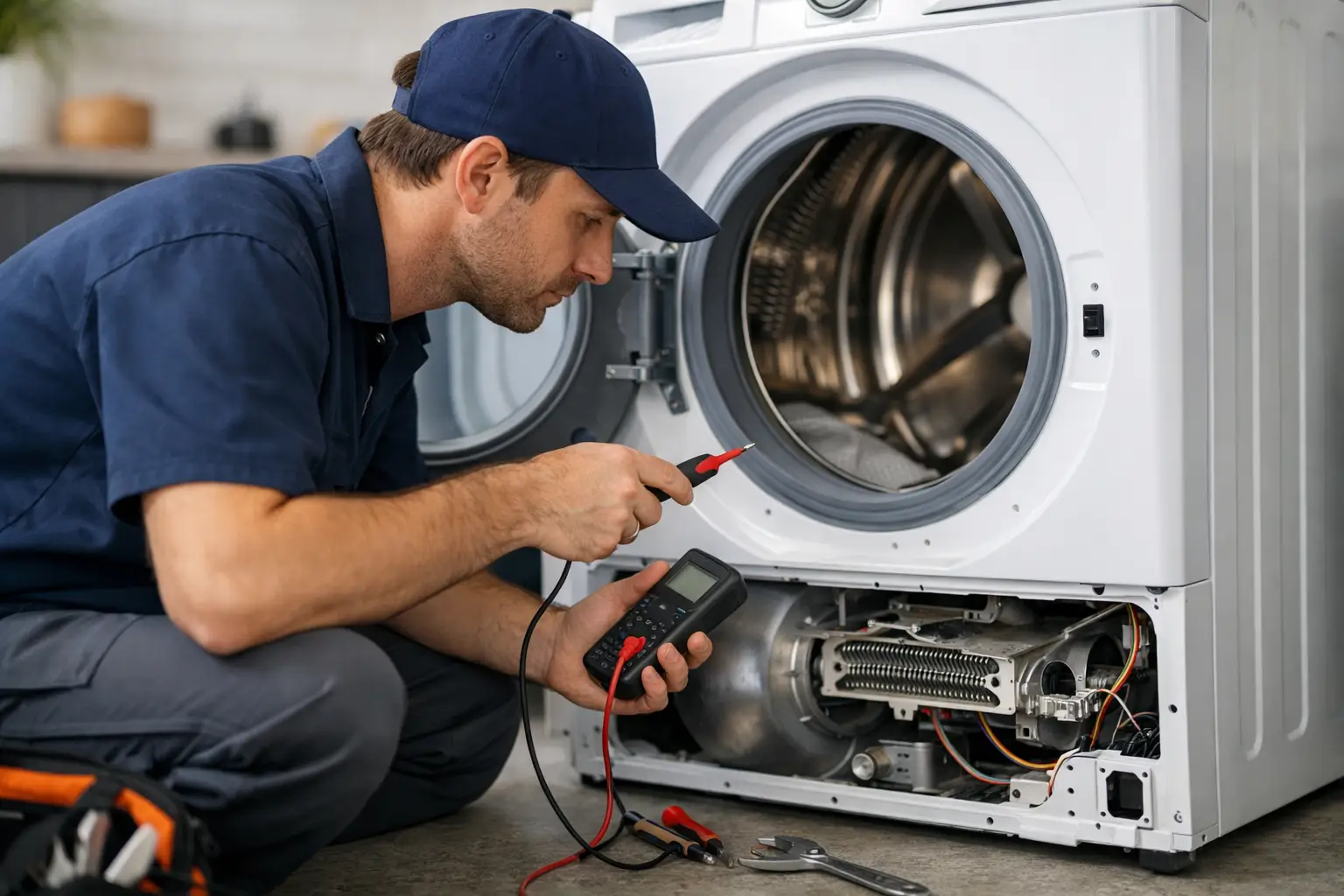
A dryer that tumbles normally but delivers cold air can turn a simple laundry day into a pile of damp clothes and repeat cycles. This dryer no heat repair example shows why the symptom is not enough to identify the failed part. A working drum motor only confirms that one section of the appliance is operating. The heat circuit, airflow path, safety controls, and power supply still need to be tested correctly.
For most homeowners, the practical question is whether the dryer can be repaired promptly and whether the repair will last. The answer depends on the diagnosis, not on replacing the most commonly mentioned part first.
A Dryer No Heat Repair Example From a Typical Service Call
Consider an electric dryer that spins, runs its full cycle, and displays no error code, yet clothes remain cold and wet after 60 minutes. The homeowner has already cleaned the lint screen and tried a second cycle. Because the dryer is still turning, it is tempting to assume the heating element is the only possible issue.
During a professional diagnosis, the technician first verifies the dryer is receiving the proper power. Most electric dryers use 240 volts for heating and 120 volts for controls and the motor. A partially tripped double breaker, damaged outlet, or failed leg of power can allow the drum to turn while preventing the heating element from producing heat. This is one reason a dryer can appear to be running normally even when it cannot dry clothing.
If voltage is correct, the technician checks the heating circuit. On a common electric dryer, that may include the heating element, thermal fuse, high-limit thermostat, cycling thermostat, wiring connections, and control board or timer contacts. Each component has a specific job. Replacing one without testing the rest can lead to an unnecessary repair or a repeat failure.
In this example, testing found an open thermal fuse. That fuse had interrupted the heat circuit as a safety measure. However, the failed fuse was not treated as the full diagnosis. The technician then inspected the venting and found a restricted exterior vent hood and lint buildup in the vent run. Excess heat from poor airflow likely caused the fuse to open.
The completed repair involved replacing the failed safety component and correcting the airflow issue. After reassembly, the dryer was run through a heating test to confirm proper operation. This is the difference between replacing a part and resolving the condition that caused it to fail.
Why a Dryer Runs but Has No Heat
Dryers rely on several systems working together. A problem in any one of them can leave you with a tumbling drum and cold air. The likely cause also changes based on whether the appliance is electric or gas.
Electric dryer causes
An electric dryer with no heat may have a failed heating element, blown thermal fuse, defective thermostat, damaged wiring, or a power supply problem. Heating elements can burn out over time, but they can also fail prematurely if airflow is restricted and the dryer overheats.
A thermal fuse is often a one-time safety device. If it is open, it usually needs replacement. Still, a qualified technician should identify why it opened. Installing a new fuse without addressing a blocked vent, crushed flex duct, or malfunctioning thermostat can result in another no-heat call soon afterward.
Gas dryer causes
Gas dryers require a different diagnostic approach. The drum may turn while the burner fails to ignite. Common causes include failed igniter components, faulty gas valve coils, flame sensor problems, thermostat failures, or an issue with the gas supply.
Gas appliance repairs should not be guessed at. The technician needs to confirm ignition sequence, gas flow, flame operation, and safety controls. If you smell gas, turn off the appliance if it is safe to do so, leave the area, and contact the gas utility or emergency services as appropriate before arranging repair.
Airflow Is Part of the Repair, Not an Extra Detail
A restricted vent is one of the most overlooked causes of dryer trouble. When hot, moist air cannot leave the home efficiently, drying time increases. The dryer may run hotter than designed, safety parts may fail, and energy use can climb because each load takes longer.
The lint screen should be cleaned after every load, but that is only the starting point. Lint can build up in the duct behind the dryer, at turns in a long vent run, and at the outside termination. Homes with laundry rooms located toward the center of the house may have longer vent paths, which can make maintenance especially important.
Watch for warning signs such as clothing that takes more than one cycle to dry, a laundry room that feels unusually hot, a burning smell, excessive lint around the dryer, or weak air movement at the outside vent hood. These signs do not always mean the heating part has failed. They do mean the appliance should be checked before the issue becomes more expensive or creates a safety concern.
What a Professional Dryer Diagnosis Should Include
A dependable no-heat repair begins with testing rather than assumptions. The technician should confirm the model information, listen to the customer’s description of the failure, and inspect the appliance for visible damage or airflow concerns. From there, diagnosis typically includes checking the power source or gas supply, testing heat-related components, inspecting wiring and connections, and verifying operation after the repair.
The exact process depends on the brand and model. Some dryers use mechanical timers and straightforward thermostats. Others use electronic control boards, moisture sensors, diagnostic modes, and more complex wiring. A board should not be blamed simply because it is expensive or difficult to access. It should be supported by proper test results.
Using genuine or manufacturer-approved parts matters as well. Dryer safety components are designed for specific operating temperatures and electrical characteristics. A part that looks similar may not provide the same protection or performance.
Repair or Replacement: What Makes Sense?
A no-heat dryer is often repairable, particularly when the issue is a thermal fuse, heating element, thermostat, igniter, or gas valve coil. The age of the dryer, overall condition, availability of parts, and repair cost all affect the decision.
If the dryer has been reliable, has no major drum or motor problems, and needs a focused heat-system repair, fixing it is commonly the sensible choice. On the other hand, replacement may deserve consideration when an older appliance has multiple failures, severe corrosion, major control board damage, or a repair that approaches the value of a comparable new unit.
A professional technician can explain the findings clearly and give you the trade-off. That allows you to decide based on the appliance’s condition rather than on guesswork or the inconvenience of damp laundry.
Avoid These Common No-Heat Mistakes
Do not keep running a dryer through repeated long cycles in hopes that the heat will return. This wastes energy, adds wear to the motor and drum components, and can make an airflow problem worse. Avoid bypassing a thermal fuse or thermostat. Those components are safety devices, and bypassing them can create a serious fire risk.
It is also wise not to order a heating element based on a symptom alone. A power supply issue, open fuse, failed control, or ventilation restriction can produce the same no-heat complaint. A correct diagnosis protects your budget and helps prevent a second repair visit for the same problem.
If your dryer is running without heat in Irvine or elsewhere in Orange County, a trained technician can identify the cause, check the vent-related conditions, and complete a warranty-backed repair when practical. For prompt local appliance service, visit our Google Business Profile.