


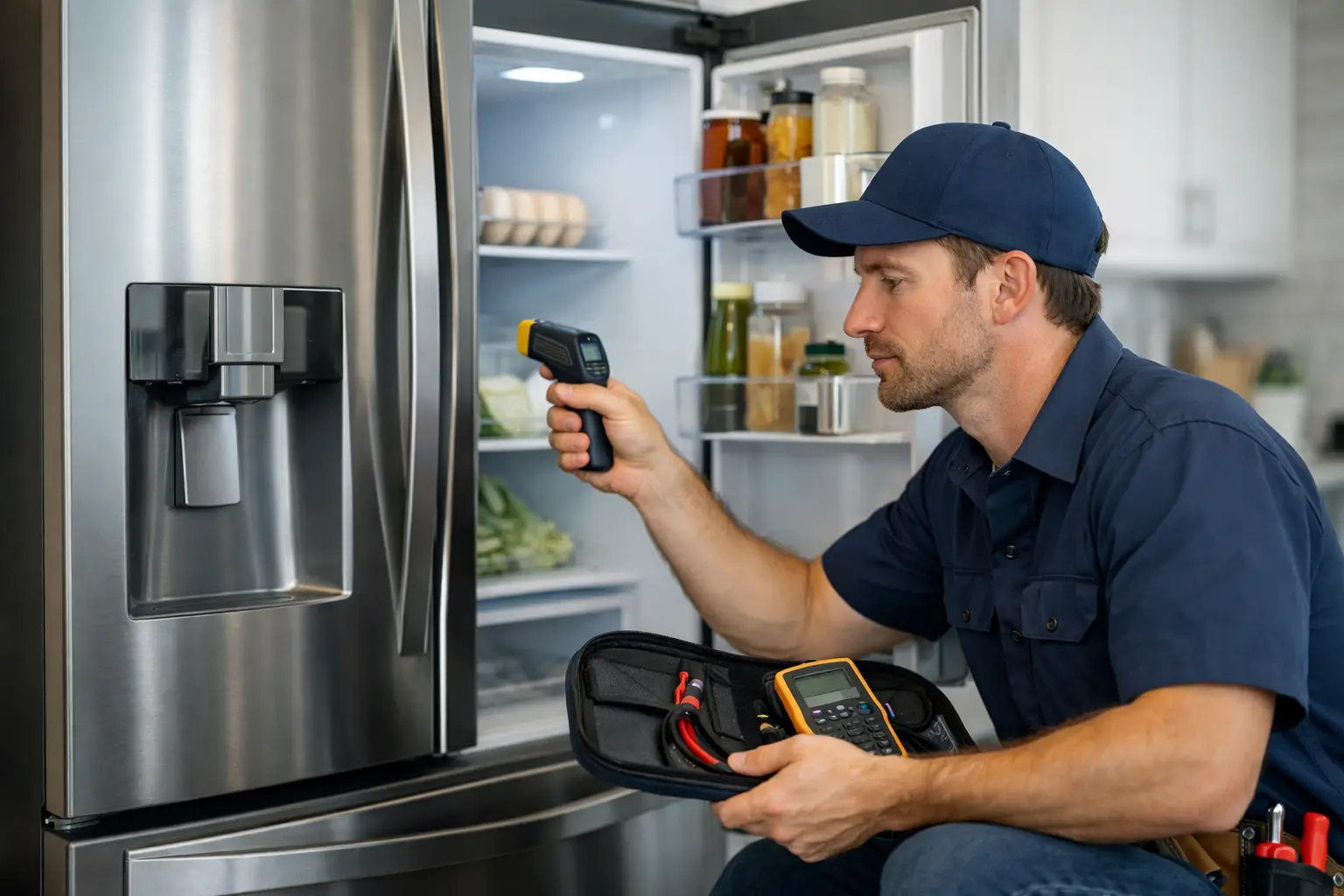
When a GE refrigerator is not cooling, the problem usually shows up fast – milk gets warm, produce softens, and the freezer may still seem partly cold enough to cause confusion. For most homeowners, this is not a situation to monitor for a few days. It is a same-day problem because food loss, water leaks, and compressor strain can all follow if the unit keeps running without cooling properly.
In many cases, the refrigerator is still powered on, the lights work, and the fans may even be running. That is what makes this issue frustrating. A refrigerator can look normal from the outside while failing in one of the core systems that actually move cold air or remove heat. The right response is not guesswork. It is a clear diagnosis.
Why a GE refrigerator not cooling is rarely just one issue
Cooling problems do not come from one universal part failure. On a GE unit, the cause may be restricted airflow, a failed evaporator fan, a defrost problem, a bad thermostat or sensor, a control board issue, dirty condenser coils, a weak compressor, or a sealed system fault. Two refrigerators can have the same symptom and need completely different repairs.
That matters because replacing the wrong part wastes time and money. It also delays the actual repair while temperatures inside the fresh food section continue to rise. If the refrigerator is only slightly cool, that does not necessarily mean the problem is minor. Some major failures begin with partial cooling before the unit stops cooling altogether.
The most common causes behind cooling failure
One common issue is poor airflow. If the evaporator fan is not circulating cold air from the freezer into the refrigerator section, the fresh food side often warms up first. Homeowners sometimes assume the whole refrigerator is dead, when the cooling system is still producing some cold air but not distributing it correctly.
Another frequent cause is frost buildup on the evaporator coil. When the defrost system fails, ice can block airflow and make the refrigerator section warm while the freezer becomes less consistent over time. This is the kind of problem that may look temporary if temperatures go up and down, but it usually gets worse until the airflow is heavily restricted.
Dirty condenser coils can also push temperatures up, especially in busy households where the refrigerator runs hard every day. When coils are packed with dust and pet hair, heat cannot release efficiently. That forces longer run times and can make the refrigerator struggle to hold safe temperatures. In some cases, this is a maintenance issue. In others, it is only one part of a larger repair need.
Then there are control-related failures. GE refrigerators often rely on sensors, control boards, and damper systems to manage cooling between compartments. If one of those components stops reading or responding correctly, the unit may cool unevenly, cycle at the wrong times, or stop maintaining temperature altogether.
Signs the problem is getting more serious
A cooling issue becomes more urgent when the freezer starts softening food, the refrigerator compartment climbs well above normal temperature, or the compressor seems to run constantly without reaching the set temperature. Clicking sounds, repeated attempts to start, or unusual silence from the fans can also point to a more significant mechanical or electrical problem.
Water under the refrigerator can add another layer to the diagnosis. Sometimes it is a blocked defrost drain. Sometimes it is condensation from poor cooling. Sometimes it signals an ice buildup problem that is already affecting airflow inside the cabinet.
The age of the unit matters too, but not always in the way people expect. An older refrigerator may still be worth repairing if the issue is limited to a fan motor, thermostat, sensor, or defrost component. A newer model with a sealed system or compressor problem can become expensive much faster. That is why diagnosis should come before assumptions about replacement.
What homeowners can check before calling
There are a few practical checks that make sense before scheduling service. First, verify that the temperature settings were not accidentally changed. It happens more often than people think, especially in homes with children or after loading groceries.
Next, check whether the vents inside the refrigerator and freezer are blocked by food containers. Good airflow matters. If cold air cannot circulate, temperatures can become uneven even when the cooling system is trying to work.
You can also inspect the condenser area for heavy dust buildup if it is safely accessible. If the coils are visibly dirty, cleaning may help performance. Still, if the refrigerator is clearly not holding temperature, coil cleaning should not be treated as a guaranteed fix.
Listen for the evaporator fan and compressor. If the lights are on but the refrigerator is quiet when it should be cooling, that gives a technician useful information. If it is running nonstop without getting cold, that is useful too.
Beyond those basic checks, most cooling failures are not practical DIY repairs. Modern GE refrigerators use interconnected electrical and mechanical systems, and incorrect part replacement can create a more expensive service call later.
When to stop waiting and book service
If food is already warming, if the freezer is no longer freezing solid, or if the refrigerator has been running for hours without improving, waiting usually works against you. The longer the unit runs in a failed state, the more stress it can place on key components.
This is especially true when the issue may involve the compressor, start device, control board, or defrost system. Those are not problems that resolve on their own. Intermittent cooling can be just as serious as complete cooling loss because it often indicates a part failing under load.
For families, busy households, and homeowners managing a full kitchen, the real cost is not just the repair. It is spoiled groceries, disrupted routines, and the possibility of needing emergency replacement if the problem is ignored too long.
Repair or replace? It depends on the actual fault
A GE refrigerator not cooling does not automatically mean replacement is the smart move. Many cooling issues are repairable, and a targeted repair is often the more cost-effective path when the refrigerator is otherwise in good condition.
If the problem is a fan motor, thermostat, sensor, control component, or defrost part, repair is commonly the better value. If the issue is a sealed system leak or compressor failure, the decision depends on the model, age, condition, and repair cost. That is where an experienced technician adds real value – not by guessing, but by identifying the failed component and explaining whether the repair makes financial sense.
Homeowners are usually not looking for theory in this situation. They want to know whether the refrigerator can be fixed, how soon the problem can be identified, and whether the repair is worth approving. A professional diagnosis answers those questions quickly.
Why brand-specific experience matters for GE cooling issues
GE refrigerators are common, but that does not mean every cooling problem is simple. Different models use different control systems, fan setups, defrost components, and temperature management designs. Side-by-side units, French door refrigerators, and top-freezer models can all fail differently.
That is why experience with the brand matters. The right technician knows what failures are common, what symptoms tend to point to airflow versus sealed system issues, and which parts are worth testing first. It shortens downtime and improves the odds of fixing the problem in as few trips as possible.
For homeowners in Irvine and across Orange County, fast service matters when refrigerator cooling drops off without warning. A professional appliance repair company with stocked genuine parts, trained technicians, and local availability can often make the difference between a manageable repair and a much bigger disruption.
If your GE refrigerator is not cooling and you need a dependable local diagnosis, Prostar Appliance Service helps homeowners across the area with prompt, professional refrigerator repair. You can learn more about local service availability through our Google Business Profile.