


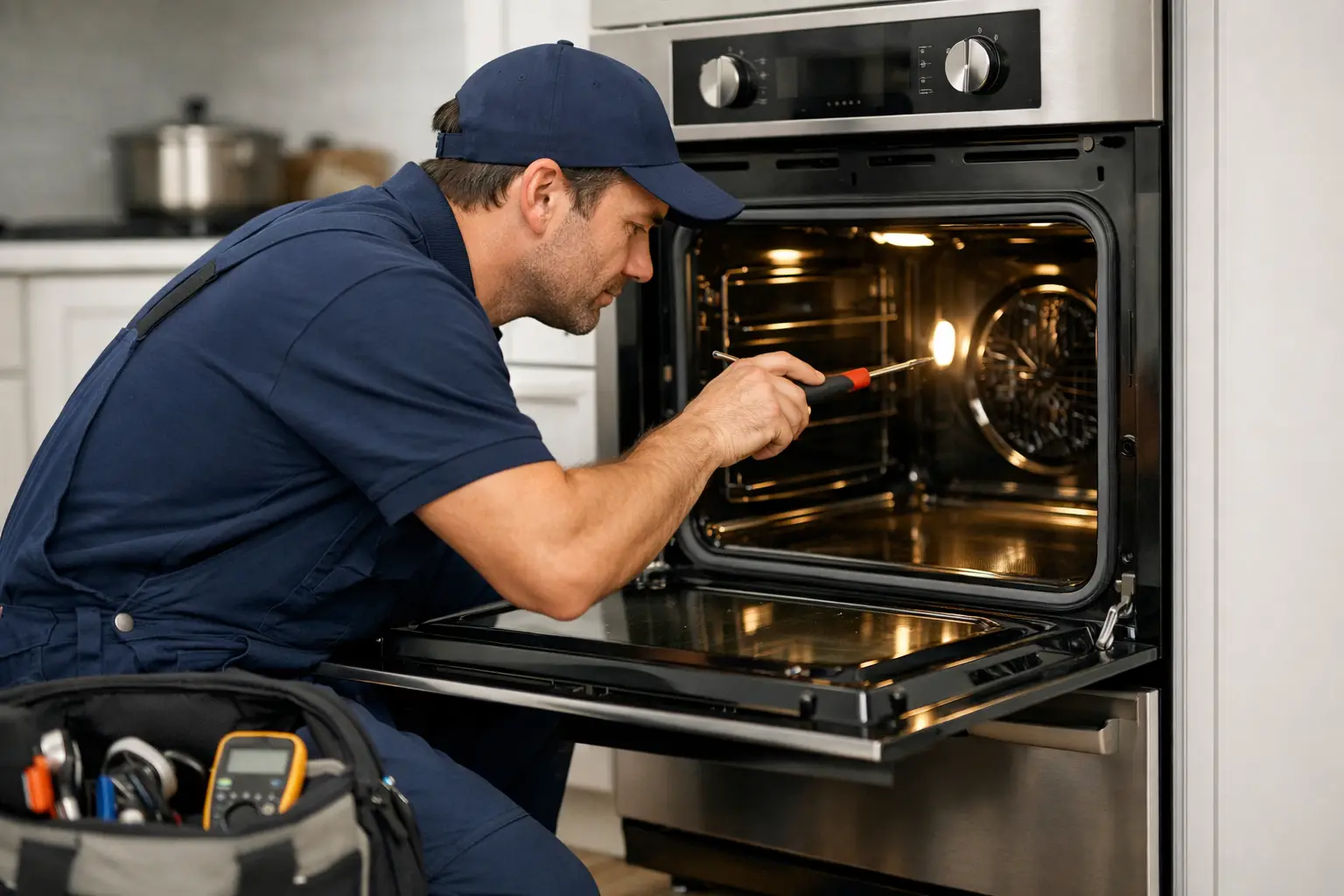
When your oven stops heating before dinner or starts cooking everything unevenly, the question usually is not whether you need help – it is how oven repair service works and how quickly the problem can be resolved. Most homeowners are not looking for a lesson in appliance mechanics. They want a clear process, an honest diagnosis, and a repair that holds up.
That is exactly what a professional oven service call is meant to provide. A good repair company does more than show up with a toolbox. The job starts with narrowing down the symptom, confirming the cause, and fixing the issue in the fewest trips possible. For a household that depends on a working kitchen, speed matters, but so does accuracy.
How oven repair service works from the first call
The process usually begins with a short conversation about the problem. The technician or office staff may ask whether the oven is electric or gas, whether it will not heat at all, whether it overheats, whether the broiler works, or whether the control panel is unresponsive. Those details help set expectations before the appointment and can sometimes point to the most likely failed part.
In many cases, homeowners want a quick price over the phone. That is understandable, but oven repair is rarely that simple. The same symptom can come from different causes. An oven that will not heat might have a bad bake element, a failed igniter, a temperature sensor issue, a blown thermal fuse, wiring damage, or a control board problem. Until the unit is tested properly, any quote is only an estimate.
Once the appointment is scheduled, the technician arrives to inspect the appliance in person. This is where the real work starts. Professional diagnostics are what separate a lasting repair from guesswork.
What happens during the diagnosis
A proper oven diagnosis is methodical. The technician will usually begin by confirming the complaint and observing how the oven behaves. If the display is working but the oven does not heat, that points in one direction. If it trips the breaker, gives an error code, smells like gas, or heats inconsistently, the testing approach changes.
Common problems a technician checks first
For electric ovens, heating elements, temperature sensors, wiring, relays, and electronic control boards are common failure points. For gas ovens, igniters are one of the most frequent causes of no-heat or slow-heat complaints. Door switches, thermostats, thermal cutoffs, and damaged harness connections can also be involved.
The technician may use a meter to test continuity, voltage, resistance, and component response. In some cases, visual signs help immediately, such as a blistered bake element or a weak igniter that glows but does not draw enough current to open the gas valve. In other cases, the problem takes longer to isolate because one failed part has affected another.
Why symptom-based guessing can waste time
An oven that seems to have a bad element may actually have a control issue sending no power to that element. A temperature complaint may not be a bad sensor at all – it could be calibration drift, a failing relay, or even a door seal problem causing heat loss. That is why experienced repair service is built around testing, not assumptions.
This matters for cost control. Replacing the wrong part first often leads to extra labor, extra downtime, and a second appointment that could have been avoided.
After diagnosis: repair options and approval
Once the cause is confirmed, the technician explains what failed, whether the repair is practical, and what the next step looks like. This part should be straightforward. You should know which component is bad, whether the part is available, what the labor involves, and whether the appliance is worth repairing based on age and overall condition.
Not every oven problem should be repaired automatically. If a unit has a failed control board on an older model and the replacement part is discontinued or unusually expensive, replacement may make more sense. On the other hand, if the issue is an igniter, element, sensor, or switch on an otherwise solid appliance, repair is often the more cost-effective option.
A professional service company should also be realistic about timing. Some repairs can be completed the same day if the technician has the part in stock. Others require an order, especially for model-specific boards, panels, or uncommon brand parts.
How the actual oven repair is completed
Once approved, the technician carries out the repair safely and tests the oven again before closing the job. That usually includes removing the failed part, installing the replacement, checking wiring and connectors, reassembling the unit, and confirming proper operation through a heat cycle or functional test.
For gas ovens, safety is a major part of the service. Ignition performance, valve operation, and proper heating response need to be verified carefully. For electric ovens, the technician may confirm voltage delivery, element cycling, sensor readings, and control response. The goal is not just to swap a part, but to make sure the oven is working the way it should.
Same-day repair versus return visit
A lot depends on parts availability. Companies that keep common genuine parts on hand can often complete repairs faster, especially for frequent failures like igniters, bake elements, sensors, and fuses. If the part is not on the truck, a return visit may be necessary.
This is one reason homeowners often prefer established local companies with stocked inventory and broad brand experience. The fewer trips required, the less disruption to your schedule.
How oven repair service works when parts are needed
When a part has to be ordered, the service process should stay simple. The technician identifies the exact part using the oven’s model information, confirms compatibility, and schedules the follow-up once the part arrives. A reliable repair company does not leave customers guessing about next steps.
Genuine replacement parts matter here. Aftermarket components can sometimes work, but quality and fit are not always consistent. For critical oven components, using the right part helps protect performance, safety, and long-term reliability.
There is also a practical trade-off. Sometimes the fastest option is available immediately, while the best factory part may take longer. In many cases, the right answer depends on the age of the appliance, how urgently you need the oven back, and whether the difference affects durability.
What affects cost and repair time
Homeowners usually want to know two things: how much and how long. The honest answer is that both depend on the failure.
A straightforward heating element or igniter replacement is usually less involved than a control board issue or wiring repair hidden behind the unit. Brand, model, part availability, oven configuration, and installation access all play a role. A wall oven can take more time to service than a standard freestanding range because removal and reinstallation are more labor-intensive.
The age of the appliance matters too. Older units can be very repairable if parts are still available, but some become less practical when major electronic components are discontinued. Newer ovens may have more advanced controls and diagnostics, but they can also involve more expensive parts.
What you want from the service company is clarity. You should understand whether the problem is minor, moderate, or major, and whether the repair is likely to restore dependable operation.
When to call instead of waiting
Some oven issues get worse if they are ignored. A weak igniter may still light the burner for a while, but delayed ignition can turn into a full no-heat problem. An oven that overheats can damage food, stress internal components, and create safety concerns. Burning smells, sparking, repeated breaker trips, gas odor, or an unresponsive control panel should not be put off.
Even uneven cooking deserves attention if it happens consistently. What feels like a nuisance may be an early sign of a sensor, relay, or element issue. Catching the problem early can prevent a larger repair later.
What a good service experience should feel like
Professional oven repair should feel organized, not uncertain. The appointment should be on time, the diagnosis should be specific, and the repair should come with clear workmanship standards. Homeowners should not have to chase updates or wonder whether the technician is guessing.
That is especially important in busy households where a broken oven affects meal planning, family routines, and daily convenience. In places like Irvine and across Orange County, many customers are not comparing repair options based only on price. They are looking for responsive service, trained technicians, and a repair done right the first time whenever possible.
A warranty also matters. When a company stands behind parts and labor, it shows confidence in the repair and gives the customer a more practical level of protection after the visit.
If your oven is not heating properly, cooking unevenly, or showing signs of a larger electrical or ignition problem, professional service can save time and prevent repeat issues. For homeowners in Irvine and nearby Orange County communities, Prostar Appliance Service provides dependable oven diagnostics and repair backed by experience, stocked parts, and local responsiveness. You can learn more or check recent customer feedback on our Google Business Profile.