


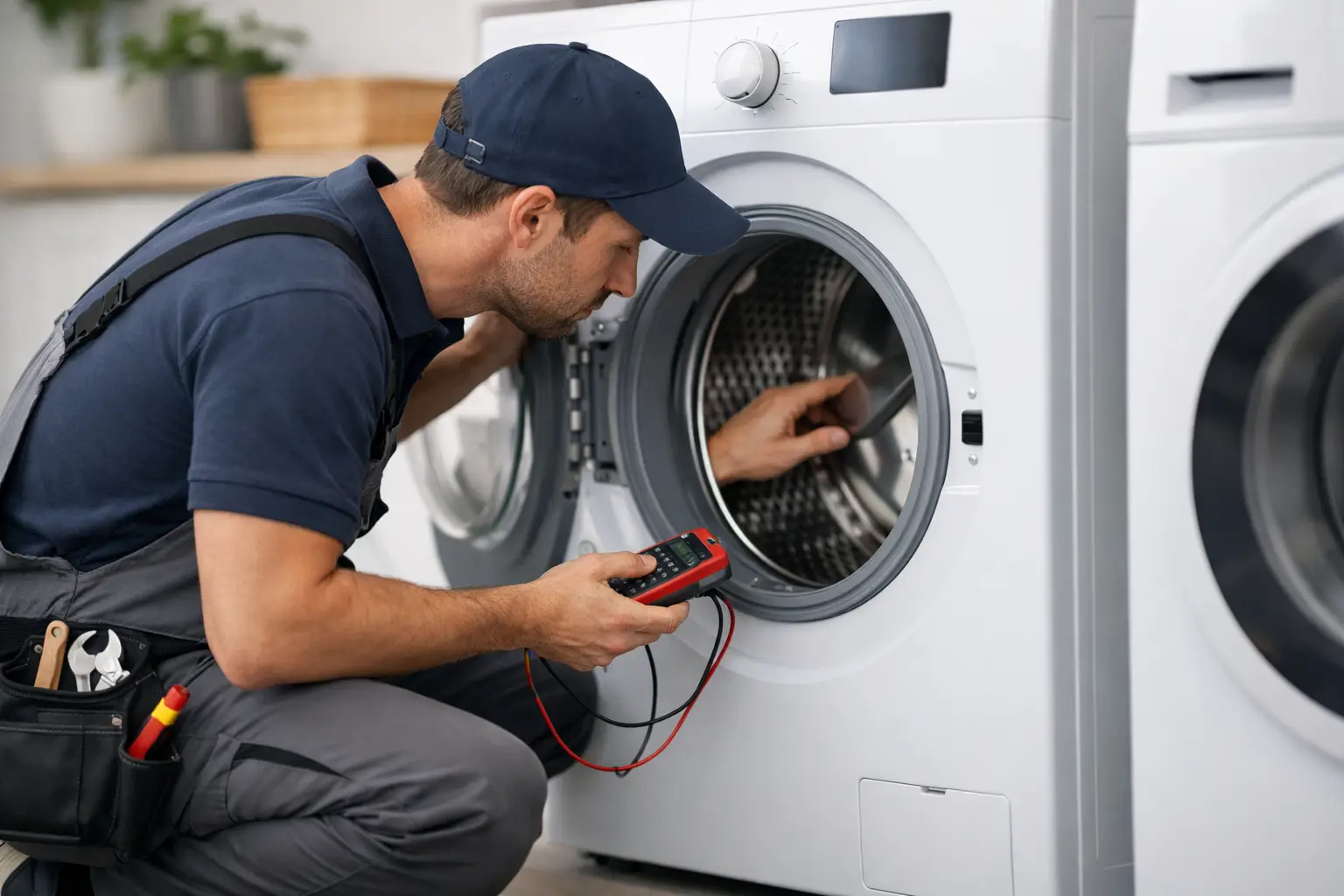
A washer that fills and drains but refuses to spin can shut down a full day of laundry fast. If you are searching for how to fix washer not spinning problems, the real question is usually whether the issue is something simple, like an unbalanced load, or a failed part that needs professional repair.
The difference matters. Some no-spin problems are quick corrections. Others point to worn drive components, lid lock failures, control issues, or a motor problem that will keep coming back until the failed part is replaced. Knowing which is which can save time, prevent water damage, and keep you from paying for the wrong repair.
Common reasons a washer stops spinning
Most washers stop spinning for one of two reasons. Either the machine is preventing the spin cycle for safety, or a key mechanical or electrical part is no longer doing its job.
Safety-related causes are often the simplest. A top-load washer may not spin if the lid switch or lid lock does not engage properly. Many front-load models will also pause or cancel high-speed spin if the door lock does not register as secure. If the load is badly unbalanced, the washer may slow down or skip spin to avoid damaging the tub and suspension.
Mechanical causes are more serious. A worn belt, failing motor coupling, damaged clutch, broken drive pulley, bad shift actuator, or failed transmission component can all stop the basket from reaching spin speed. On some models, a weak drain pump can also create what looks like a spin problem. If the washer cannot remove water properly, it may never move into a full spin cycle.
Electronic failures are also common on newer machines. A faulty control board, speed sensor, or wiring issue can interrupt the sequence even when the motor and drive parts are still intact.
How to fix washer not spinning without making it worse
Before assuming the washer needs a major repair, start with the basics. Make sure the load is not packed tightly on one side, especially with heavy towels, blankets, or jeans. Redistributing the load can be enough to let the washer spin normally on the next cycle.
Check the cycle settings next. It sounds obvious, but delicate, hand-wash, or no-spin selections are easy to miss. If the washer hums, clicks, or drains but will not ramp up into spin, cancel the cycle and restart with a normal spin setting.
If there is standing water in the tub, the problem may be drainage first, spin second. A blocked drain hose, clogged filter, or weak pump can stop the cycle before spin begins. This is especially common in front-load washers, where the machine will often refuse to spin a water-filled tub.
You can also inspect for clear signs of a lid or door lock issue. If the lid lock light flashes, the door does not latch cleanly, or the machine starts and stops repeatedly, the washer may be waiting for a lock confirmation signal it never receives. That usually needs testing with the right tools, because replacing the wrong lock assembly or control board can get expensive fast.
Washer not spinning after draining
When a washer drains but the basket still will not turn, the problem usually shifts away from the pump and toward the drive system. This is where homeowners often lose time trying resets when the real issue is a failed part.
On many top-load washers, the culprit may be a worn motor coupling, damaged belt, or bad clutch. On some brands, the shift actuator fails and the washer cannot move from agitation into spin mode. On others, a worn splutch or hub assembly allows the motor to run while the basket barely moves.
Front-load washers often point to a different set of failures. A damaged drive belt, failed stator or rotor component, worn tub bearings, or control board fault can all prevent high-speed spin. If the machine becomes very loud before spin failure, especially with a roaring or grinding sound, bearing or rear tub issues move higher on the list.
That distinction matters because some repairs are straightforward and cost-effective, while others involve major disassembly. A good diagnosis comes before part replacement.
Brand and model matter more than most people expect
Two washers can have the same symptom and need completely different repairs. Whirlpool, GE, LG, Samsung, Maytag, Kenmore, Frigidaire, and Electrolux all have common no-spin patterns, but the likely failure points vary by design.
For example, one model may commonly fail at the lid lock, while another is known for control board communication errors or drain pump restrictions. High-efficiency machines are also less forgiving when it comes to off-balance loads and sensor faults. That is why the most reliable repair process starts with the exact model number, the cycle behavior, and whether the washer drains, agitates, locks, or makes unusual noise.
Signs you are dealing with a part failure, not a minor issue
A few symptoms usually point away from a simple reset or load adjustment. If the washer smells like hot rubber, makes a burning odor, bangs hard before stopping, or produces a humming sound without basket movement, internal parts may already be under strain.
The same is true if the washer only spins when empty, stops at the same point in every cycle, trips the breaker during spin, or shows recurring error codes. Those patterns suggest that a sensor, motor circuit, control, or drive component is failing under load.
At that stage, continuing to run the washer can turn a manageable repair into a larger one. A slipping belt can damage surrounding components. A failing bearing can affect the tub assembly. A weak lock mechanism can create repeated control faults that confuse the diagnosis.
When repair makes sense and when replacement is worth considering
If the washer is otherwise in good condition, a no-spin repair is often worthwhile. Lid locks, belts, actuators, couplings, pumps, and certain motor-related parts can usually be replaced without approaching the cost of a new machine.
Replacement becomes more reasonable when the washer has multiple problems, major tub or transmission damage, severe rust, or a high-cost control and drive failure on an older unit. Age alone is not the only factor. Overall condition, brand reliability, part availability, and labor complexity all matter.
That is why a clear diagnosis is more useful than broad advice. The right answer depends on what failed, how accessible the repair is, and whether the machine has had repeated issues recently.
Why washer spin problems are easy to misdiagnose
A washer that will not spin can look like a motor problem when the real issue is a clogged drain path. It can look like a bad control board when the failed component is the lid lock. It can even seem like the basket is seized when the machine is simply preventing spin because the load sensing system detected imbalance.
This is where experience makes a difference. Appliance technicians do not just look at the symptom. They trace the sequence. Does the unit lock? Does it drain fully? Does the motor energize? Does the basket try to move? Is the error consistent? That process narrows the fault quickly and reduces unnecessary parts replacement.
For homeowners, that means less guessing and fewer delays. It also means less chance of ordering a part that cannot be returned after installation.
The fastest next step if your washer is not spinning
If the washer has one isolated issue and no standing water, you can try rebalancing the load and rerunning a proper spin cycle once. If it still fails, or if you notice water left in the tub, burning odor, unusual noise, flashing lock lights, or repeat error codes, it is time to have the machine diagnosed.
For busy households, the practical goal is not learning every washer component. It is getting the problem identified correctly and repaired with as few interruptions as possible. That is especially true when the washer is a daily-use appliance and delays start piling laundry up fast.
If your washer is not spinning and you need dependable appliance repair in Irvine or across Orange County, Prostar Appliance Service can help diagnose the issue and repair major washer brands with professional service and warranty-backed workmanship. You can learn more or contact the team through our Google Business Profile.