


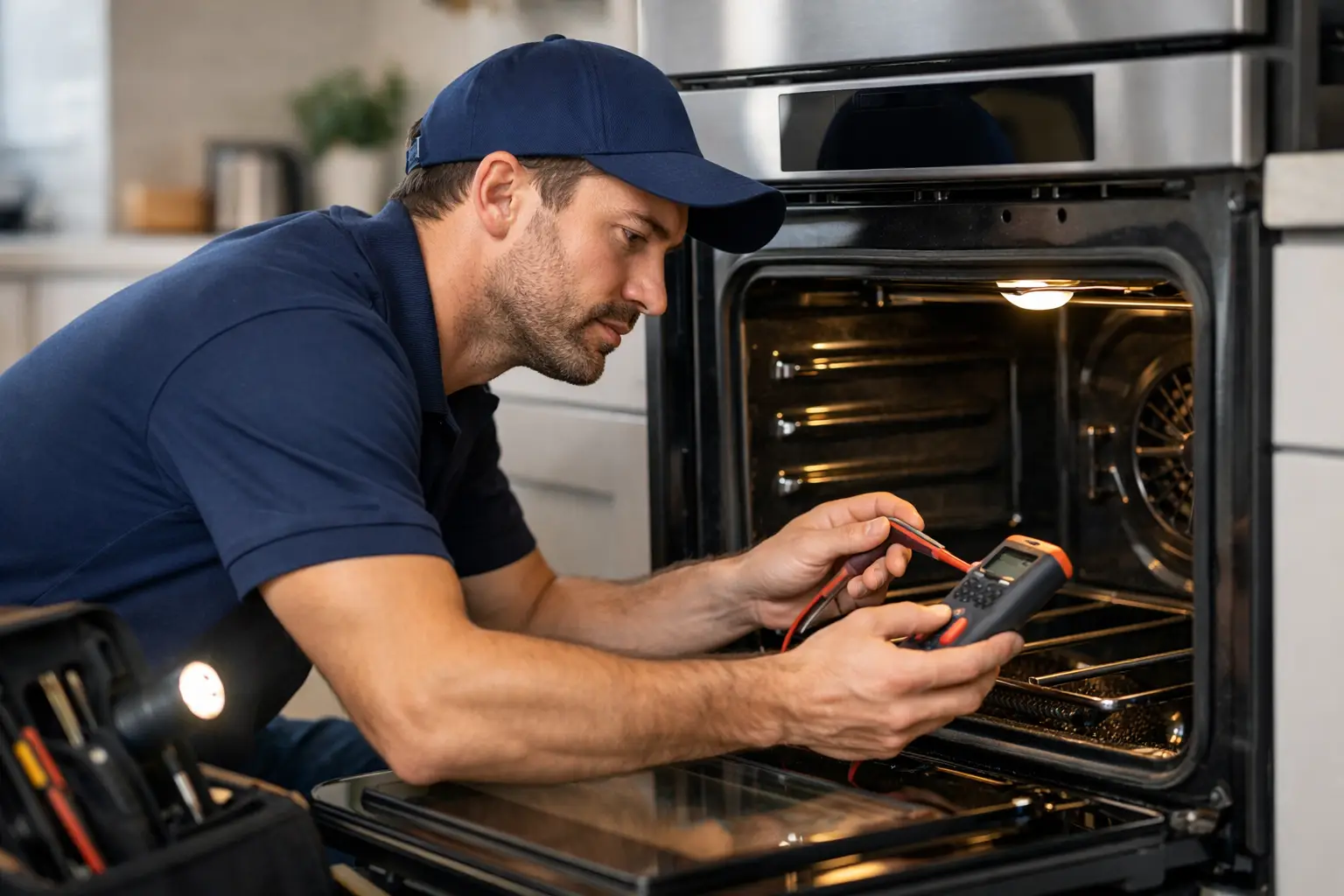
Dinner gets delayed fast when you preheat the oven, wait ten minutes, and nothing happens. If you are searching for how to troubleshoot oven not heating problems, the goal is usually simple – find out whether it is a quick fix, a parts failure, or a repair that should be handled by a trained technician before you lose more time.
An oven that will not heat can fail in a few different ways. Sometimes it does not turn on at all. Sometimes the display works, the light comes on, and the fan runs, but the cavity never gets hot. In other cases, it heats a little but never reaches the set temperature. Those symptoms point to different causes, and the right next step depends on whether you have a gas oven, an electric oven, or a range with electronic controls.
How to troubleshoot oven not heating without guessing
The first step is to separate a true heating failure from a settings issue. It sounds basic, but many service calls start with the oven being in delay mode, demo mode, or set to broil when the customer expected bake. If the control panel is responsive, confirm the time and cooking mode, then cancel the cycle and start a fresh bake setting at 350 degrees. Give it a few minutes and listen for normal operation.
With an electric oven, you may hear relays click before the bake element starts heating. With a gas oven, you may hear the igniter begin to draw current before the burner lights. If there is no change at all, the issue may be electrical supply, a failed control component, or an internal safety fault.
Power supply is one of the most overlooked causes. An electric oven can appear to have power because the clock and lights still work, while one side of the 240-volt supply has dropped. In that situation, the control panel may look normal, but the heating elements will not operate correctly. If the unit was recently installed, moved, or had a breaker trip, check the home electrical panel first. A partially tripped breaker can cause confusing symptoms.
If the breaker is fully on and the oven still will not heat, avoid repeated resets. When the same problem returns right away, it usually means a component has failed and continued use can make the repair more expensive.
What causes an oven to stop heating?
The most common failures are not the same for every oven type. Electric ovens often stop heating because of a broken bake element, a damaged broil element, a bad temperature sensor, a failed relay on the control board, or wiring damage near a high-heat connection. Gas ovens more often have trouble with a weak igniter, a failed safety valve, or control problems that prevent ignition.
There is also a difference between an oven that never heats and one that heats poorly. If it never gets warm, the fault is usually a major component failure or power issue. If it gets warm but struggles to maintain temperature, the problem may be a weak element, a drifting sensor, or an igniter that has become too weak to open the gas valve consistently.
Age matters too. On older units, heat-related wear on connectors and terminals is common. On newer electronic models, sensor and control board faults are more common than customers expect. That is why the same symptom can lead to very different repairs depending on the brand and design.
Electric oven checks
If you have an electric oven and the bake function is not working, look at the bake element once the oven is turned on for a short period. In many models, it should begin to glow red as it heats. If it stays dark and you can see blistering, cracks, or a separated section on the element, that is a strong sign it has failed.
The broil element matters too. Some ovens use both bake and broil functions to regulate preheat and maintain temperature. A failed broil element can create slow heating or uneven cooking, even if bake still works somewhat. That is one reason customers sometimes describe the problem as bad performance instead of total failure.
A temperature sensor can also cause trouble. If the control receives inaccurate temperature data, it may shut heating off too early or fail to regulate properly. In some cases, the oven throws an error code. In others, there is no code at all, just poor heating and long cook times.
What homeowners should not do is remove panels or test live voltage without the right tools and training. Electric ovens use high voltage, and control diagnostics are not a safe guess-and-check project.
Gas oven checks
For a gas oven, the igniter is often the first suspect. A weak igniter may glow but still fail to pull enough current to open the gas valve. That creates a frustrating symptom: the oven looks like it is trying to start, but no flame appears and no heat builds.
This is where visual inspection can be misleading. Customers often assume that if the igniter glows, it must be good. In reality, gas oven igniters commonly weaken over time before they fail completely. Proper diagnosis usually requires current draw testing, not just looking for a glow.
If there is no glow at all, the problem could still be the igniter, but it could also be the control, wiring, or another failed component in the ignition circuit. Because gas systems involve both electrical and fuel components, this is usually the point where professional service makes the most sense.
When the oven heats unevenly or too slowly
Not every no-heat complaint is truly no heat. Some ovens are heating, just not well enough to be useful. If preheat takes far longer than usual, food cooks unevenly, or the display says preheated long before the oven is actually hot, the issue may be partial element failure, sensor inaccuracy, or a control problem.
Door issues can contribute as well. A worn door gasket lets heat escape, which can make the oven seem weak or slow. That said, a bad gasket alone usually does not cause a complete no-heat condition. It is more often a secondary issue that makes an existing heating problem feel worse.
Recent self-clean use is another clue. High heat from the self-clean cycle can stress sensors, thermal fuses, control boards, and wiring. If the oven stopped heating right after self-clean, that timing is worth mentioning during service because it helps narrow the diagnosis faster.
Signs you should stop troubleshooting and schedule repair
There is a practical limit to how far most homeowners should go. If the breaker is on, the settings are correct, and the oven still does not heat, the next steps usually involve component testing. That means electrical measurements, access to internal parts, and brand-specific diagnostics.
You should stop using the appliance and schedule service if you notice a burning smell, visible sparking, clicking without ignition, tripped breakers, error codes that return, or inconsistent heating that affects cooking results. Those signs point to failing parts, and continued use can cause added damage.
There is also the question of time. For most households, an oven problem is not something you want to monitor for a week while meals get disrupted. A proper diagnosis identifies whether the repair is a straightforward part replacement or whether the appliance has a larger control or wiring issue. That saves time and avoids ordering the wrong part based on symptoms alone.
Why accurate diagnosis matters
The reason oven repairs get misdiagnosed so often is that several failures can produce the same symptom. A non-heating electric oven could be a bad element, bad relay, open sensor circuit, failed thermal protection device, or lost leg of power. A gas oven that does not bake could have a weak igniter, valve issue, or control fault. Replacing the first part that seems likely is not always the cheapest path.
That is why service experience matters, especially on major brands with different heating systems and control designs. An experienced technician can usually narrow the fault quickly, confirm it with testing, and complete the repair with the correct part instead of turning one visit into several.
If your oven is not heating and you want a fast, reliable diagnosis, Prostar Appliance Service helps homeowners throughout Irvine and Orange County identify the problem and repair it with professional workmanship and warranty-backed service. For local scheduling and recent customer feedback, visit our Google Business Profile.