


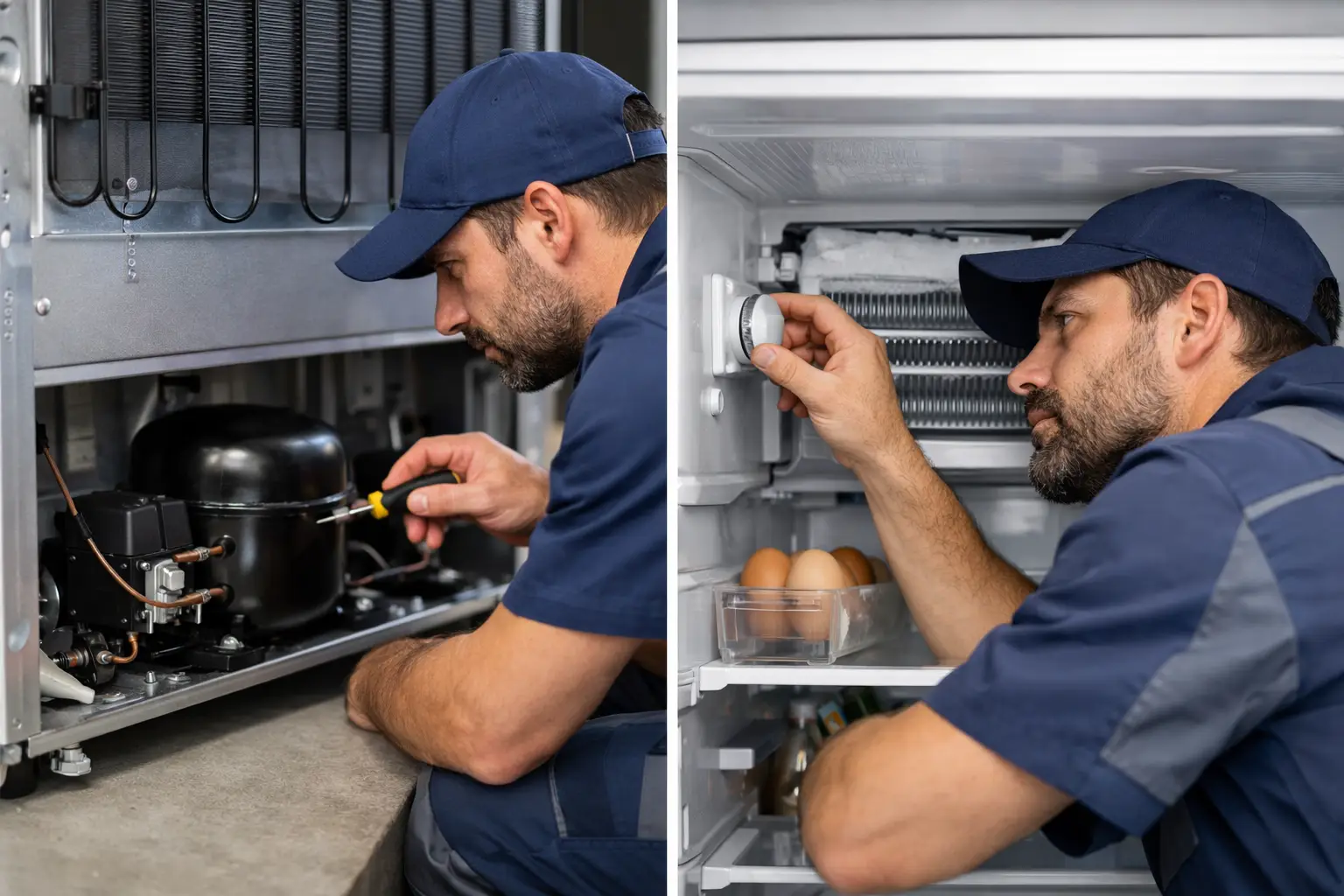
When a refrigerator starts running warm, clicking, or cycling at the wrong times, most homeowners end up searching for a refrigerator compressor vs thermostat problem because both faults can look similar at first. The difference matters. One issue may be a relatively straightforward control failure, while the other can point to a major sealed-system concern that needs prompt professional diagnosis.
A refrigerator does not need guesswork. It needs the right diagnosis early, before groceries spoil and before a small electrical or control issue creates more stress on the system. If the unit is still partially cooling, making unusual sounds, or not shutting off correctly, the symptoms can tell you a lot about whether the thermostat is misreading temperature or the compressor is struggling to do its job.
Refrigerator compressor vs thermostat problem: what each part does
The thermostat acts like the refrigerator’s temperature control switch. It monitors internal temperature and tells the cooling system when to turn on or off. In many models, especially older ones, a faulty thermostat can cause the refrigerator to run too long, not run long enough, or stop cooling altogether because the compressor never gets the proper signal.
The compressor is the heart of the cooling system. It pressurizes refrigerant and keeps cold air production moving through the sealed system. If the compressor fails, the refrigerator may stop cooling even though lights, fans, and other basic functions still seem normal. That is why compressor problems can be misleading. The unit may appear to have power, but it cannot actually produce cold temperatures.
A thermostat problem is usually a control issue. A compressor problem is usually a cooling-production issue. That distinction helps narrow things down, but real-world symptoms often overlap.
Signs the thermostat may be the problem
A bad thermostat often shows up through inconsistent operation. The refrigerator may run at the wrong times, cycle unpredictably, or fail to maintain a steady temperature from morning to night. You might notice milk getting warmer even though the freezer seems mostly fine, or the refrigerator may suddenly get too cold and start freezing food on lower shelves.
Another common sign is a compressor that does not seem to kick on when it should. In some cases, the compressor itself is still capable of working, but the thermostat is not sending the correct call for cooling. On older refrigerators with mechanical temperature controls, worn internal contacts can cause this kind of intermittent behavior.
Thermostat issues can also create a pattern where adjusting the temperature dial temporarily changes performance. If turning the control colder suddenly causes the unit to start running, then later the problem returns, that can point toward a failing thermostat. It is not a guarantee, but it is a useful clue.
The trade-off here is that modern refrigerators may use electronic control boards and sensors instead of a simple mechanical thermostat. To a homeowner, the symptom still feels like a thermostat problem, but the actual failed part may be a thermistor or control board. That is one reason an accurate service diagnosis matters more than replacing parts based on a hunch.
Signs the compressor may be the problem
A compressor problem usually looks more serious. The refrigerator may be warm in both sections, or the freezer may lose temperature first and then the fresh food section follows. You may hear clicking every few minutes, followed by silence. That clicking can happen when the compressor tries to start, fails, and shuts off again.
Another strong warning sign is a refrigerator that has interior lights and maybe even running fans, but does not cool at all. Homeowners often assume that if the appliance has power, the main system must be fine. With refrigerators, that is not true. A compressor can fail while the rest of the machine still appears alive.
Sometimes the compressor is extremely hot to the touch and the refrigerator is barely cooling. Other times it is quiet when it should be running. In either case, the issue may involve the compressor itself, the start relay, the overload protector, or another component connected to compressor startup. These parts work together, and the symptoms can overlap.
This is where professional testing is important. A failed start device can imitate a bad compressor. A restricted sealed system can imitate compressor weakness. Replacing a compressor is a major repair, so it should only happen after the technician confirms the diagnosis.
How to tell the difference by symptom pattern
If the refrigerator cools sometimes, then stops, then works again after temperature adjustments, a thermostat or control issue becomes more likely. If it is consistently warm and you hear repeated clicking or get no real cooling despite power being present, the compressor side of the system deserves close attention.
If food is freezing in the refrigerator section while the freezer seems normal, the thermostat may be regulating poorly. If both compartments are warming up together, especially over a short period, that points more toward compressor or sealed-system trouble.
Noise matters too. A thermostat issue does not usually create loud mechanical strain. A compressor issue often comes with buzzing, clicking, hard starts, or heat buildup. Still, it depends on the model and age of the unit. Some refrigerators hide early compressor trouble behind what sounds like normal operation until temperature loss becomes obvious.
That is why time matters. Waiting a few extra days to “see if it fixes itself” often turns a manageable repair visit into food loss and a more urgent service call.
Why homeowners often misdiagnose this problem
The biggest reason is simple: both failures affect cooling. From the kitchen floor, you just see warm food, soft ice cream, or a motor that does not seem to behave normally. It is easy to assume the thermostat is bad because it sounds smaller and cheaper, or to assume the compressor is gone because the refrigerator feels serious and noisy.
But refrigerators are systems, not single-part machines. A thermostat can fail, but so can temperature sensors, control boards, evaporator fans, start relays, or defrost components. Any one of those may create symptoms that blur the line between a refrigerator compressor vs thermostat problem.
That does not mean the signs are useless. It means the signs are best used to speed up a proper diagnosis, not to confirm a part replacement before testing.
What a technician checks first
A trained technician usually starts with actual operating conditions, not assumptions. That means checking temperature performance, compressor behavior, electrical supply, relay and overload function, fan operation, and control response. On some models, the tech will also inspect sensor readings or error codes.
If the thermostat or temperature control is not calling for cooling correctly, that can often be confirmed through continuity tests, control response, or diagnostic mode depending on the refrigerator design. If the compressor is suspected, the technician may test startup amperage, relay function, winding resistance, and whether the sealed system is performing as it should.
This step matters because repair cost and repair scope can be very different. A thermostat-related repair is often far less involved than a compressor replacement. But if the compressor is failing, catching it early may help avoid additional damage to food inventory and prevent repeated restart strain on electrical components.
When to stop troubleshooting and schedule service
If the refrigerator is no longer holding safe temperatures, there is not much value in waiting. The same goes for repeated clicking, a hot compressor area, spoiled food, or a unit that only cools intermittently. These are not minor convenience issues. They are signs that the refrigerator is not controlling or producing cold air properly.
For busy households, the practical question is not just what part failed. It is how fast the problem can be diagnosed and corrected with the fewest possible delays. That is especially true when the refrigerator serves a full family kitchen and downtime immediately affects meals, groceries, and daily routines.
In many cases, the best next step is a service visit that can distinguish between a control issue and a sealed-system concern before money is spent on the wrong repair. That is the difference between guessing and fixing.
If your refrigerator in Irvine or anywhere in Orange County is showing signs of a compressor or thermostat issue, prompt diagnosis can save time, food, and frustration. Prostar Appliance Service provides professional refrigerator repair backed by experienced technicians, stocked parts, and dependable local service. You can learn more or request help through our Google Business Profile.