


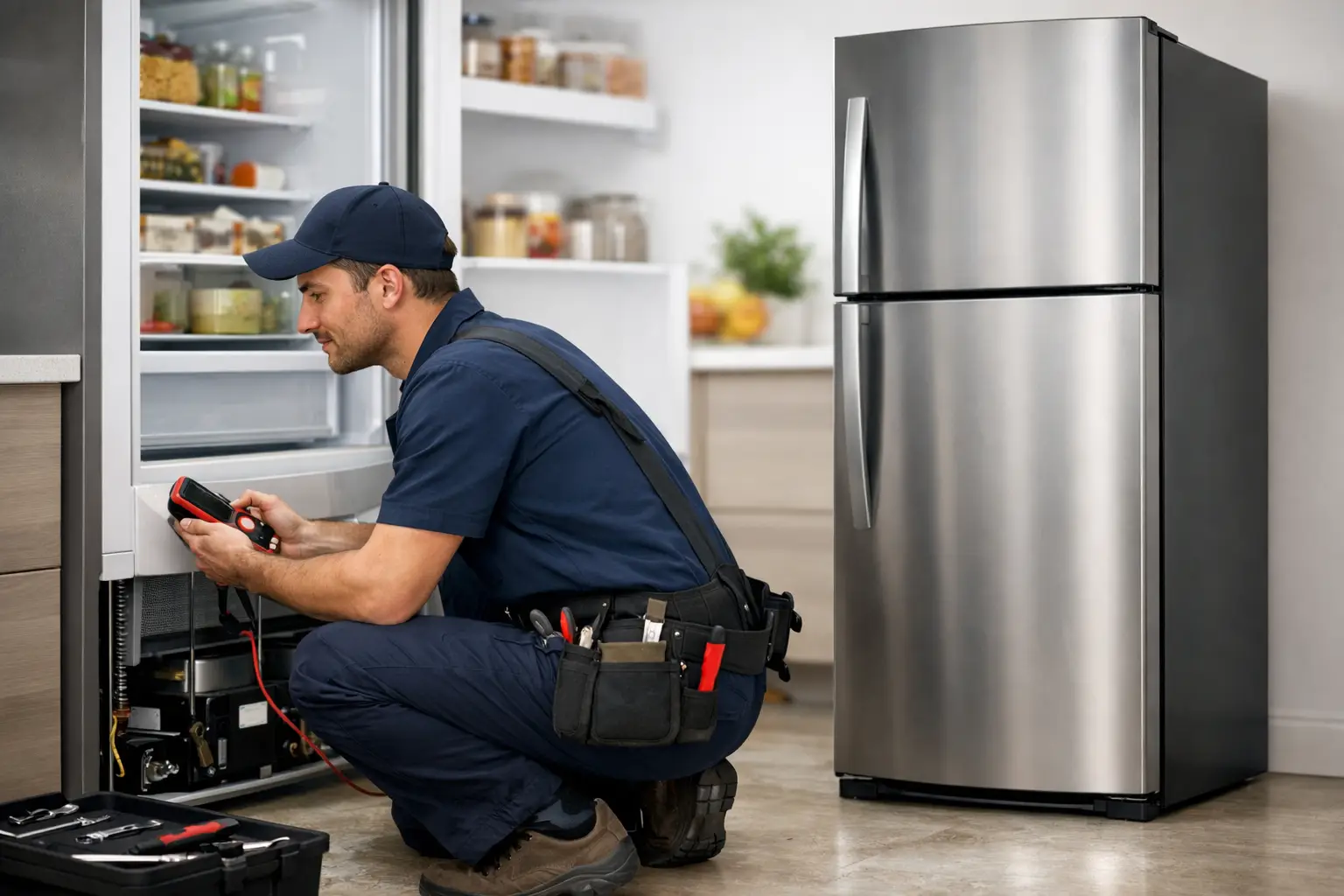
When your refrigerator stops cooling, starts leaking, or makes a noise that was not there yesterday, the question gets urgent fast: should I repair or replace my refrigerator? For most homeowners, this is not really about the appliance itself. It is about protecting food, avoiding a bigger breakdown, and making the smartest decision without wasting money.
A refrigerator is one of the few appliances that runs all day, every day. Because of that, small problems can turn expensive if they are ignored, but replacing too soon can also cost more than necessary. The right choice usually comes down to age, repair cost, performance, and whether the issue points to a one-time fix or a larger decline.
Should I Repair or Replace My Refrigerator Based on Age?
Age is one of the clearest starting points. Most refrigerators last around 10 to 15 years, although the actual lifespan depends on brand, usage, maintenance, and the type of refrigerator. A basic top-freezer model often lasts longer than a feature-heavy built-in or French door unit because there are fewer components that can fail.
If your refrigerator is under 8 years old, repair is often the better value, especially when the problem is limited to a part like a thermostat, fan motor, start relay, door gasket, or ice maker component. Many of these issues can be diagnosed and repaired without replacing the whole appliance.
If the unit is between 8 and 12 years old, the answer depends more on the type of failure and how the refrigerator has been performing overall. If it has been reliable until now and the repair is straightforward, fixing it can still make sense. If it has had repeated cooling issues, temperature swings, or multiple recent repairs, replacement starts to look more practical.
Once a refrigerator is well past 12 years old, replacement becomes more likely, particularly if the repair involves the sealed system, compressor, or control board and the unit is already showing signs of wear. At that point, you are not just paying for one repair. You may be buying a little more time on a machine that is nearing the end of its useful life.
The 50% Rule Is Useful, But Not Perfect
A common guideline is this: if the repair cost is more than 50% of the price of a comparable new refrigerator, replacement is usually the better choice. That rule is helpful, but it should not be treated as automatic.
For example, a high-end built-in refrigerator can be expensive to replace, so a repair that seems large in absolute dollars may still be worthwhile. On the other hand, a lower-cost refrigerator that needs a major compressor repair at 13 years old may not be worth saving, even if the estimate is slightly below that 50% mark.
What matters is total value, not just the estimate. Ask what you are getting from the repair. Are you solving an isolated failure on an otherwise solid refrigerator, or are you extending the life of an appliance that has already become unreliable? A professional diagnosis matters here because symptoms that look minor can point to larger system problems.
Signs Repair Usually Makes Sense
Some refrigerator issues are inconvenient but still repair-friendly. If the unit is relatively newer and the problem is limited, repair is often the more cost-effective route.
A refrigerator is usually worth repairing when it is still cooling consistently overall, the issue appeared suddenly rather than gradually, and the repair involves a replaceable component rather than a major system failure. Problems like a broken door seal, clogged defrost drain, faulty evaporator fan, bad thermostat, or malfunctioning ice maker often fall into this category.
The same is true when the refrigerator fits your space well, matches surrounding cabinetry, or would be difficult to replace quickly. In many homes, especially busy households, restoring the current unit with the right part is far less disruptive than shopping for a replacement, waiting for delivery, and dealing with installation details.
Signs Replacement Is the Better Move
Some problems point to a refrigerator that is declining overall, not just experiencing a single failure. That is when replacement becomes easier to justify.
If your refrigerator is no longer holding safe temperatures, runs constantly, develops frost repeatedly, leaks from multiple areas, or stops cooling with no clear minor cause, there may be a deeper issue. The same is true if the compressor is failing, the sealed system has a refrigerant problem, or electronic controls are failing on an older unit.
Repeated repairs are another major sign. One repair is normal over the life of an appliance. Several repairs in a short period usually mean the refrigerator is entering a more expensive phase of ownership. If you are spending money every few months and still not trusting the appliance, replacement often becomes the more stable long-term decision.
Higher energy use can also matter, although it should not be overstated. New refrigerators can be more efficient, but energy savings alone rarely justify replacing a working unit. Efficiency matters most when it is paired with age, poor cooling performance, and repair costs that are already climbing.
Problems That Sound Serious but Are Not Always the End
Homeowners often assume a refrigerator is done for when it gets loud, leaks water, or stops making ice. In reality, those symptoms can have very different causes.
A loud refrigerator may have a failing fan motor, a loose component, or a compressor issue. A water leak could be a clogged drain line, a cracked water valve, or a more involved problem. Ice maker failures are often isolated to the ice maker system and do not mean the entire refrigerator needs to go.
Even a no-cooling complaint does not automatically mean replacement. Sometimes the cause is a relay, capacitor, fan, or thermostat. Other times it is the compressor or sealed system, which is a different conversation. This is why diagnosis comes first. The symptom alone does not tell you whether repair is smart.
How to Think About Food Loss, Timing, and Stress
The repair-or-replace decision is not just financial. It is also about how much disruption your household can handle.
If your refrigerator fails suddenly and you need a working solution right away, timing matters. A repair that can be completed quickly may be worth it even if replacement is possible, especially if a new refrigerator would take days or weeks to arrive. For families managing groceries, school schedules, and work, the fastest reliable fix often has real value.
At the same time, if the unit has become unpredictable and you are worried about losing food again, peace of mind matters too. A refrigerator that keeps “mostly working” can be more frustrating than one that fails clearly. Intermittent cooling problems often create exactly that kind of stress because they are easy to ignore until food starts spoiling.
Should I Repair or Replace My Refrigerator if It Is a Premium Model?
Premium and built-in refrigerators are a separate category. These units cost much more to replace, and repairs that seem expensive on a standard refrigerator may be reasonable on a premium model. In many cases, repair is the preferred first step unless the unit has severe sealed-system problems or repeated major failures.
That said, premium does not always mean worth saving forever. Parts availability, labor complexity, and overall condition still matter. If a luxury refrigerator is older and beginning to fail in multiple areas, replacement can still be the better investment.
The Best Next Step Is a Real Diagnosis
If you are asking whether to repair or replace, you are usually already dealing with a problem that needs attention now. The most practical next step is not guessing based on age alone or shopping for a new appliance before you know the cause. It is getting a clear diagnosis from a trained technician who can tell you what failed, what the repair involves, and whether the refrigerator is likely to remain dependable after the fix.
That approach gives you real numbers instead of assumptions. It also helps you avoid replacing an appliance that could have been repaired for far less, or sinking money into a unit that is already on its way out.
For homeowners in Irvine and across Orange County, quick refrigerator diagnosis can make the difference between a manageable repair and a full kitchen disruption. If you need a professional opinion you can trust, Prostar Appliance Service provides experienced refrigerator repair backed by warranty coverage and responsive local service. You can learn more or check recent customer feedback on our Google Business Profile.
A good repair decision should leave you with confidence, not doubt. If the fix is solid and the refrigerator still has life left, repair it. If the numbers and warning signs say otherwise, replacing it sooner is often the less expensive move.