


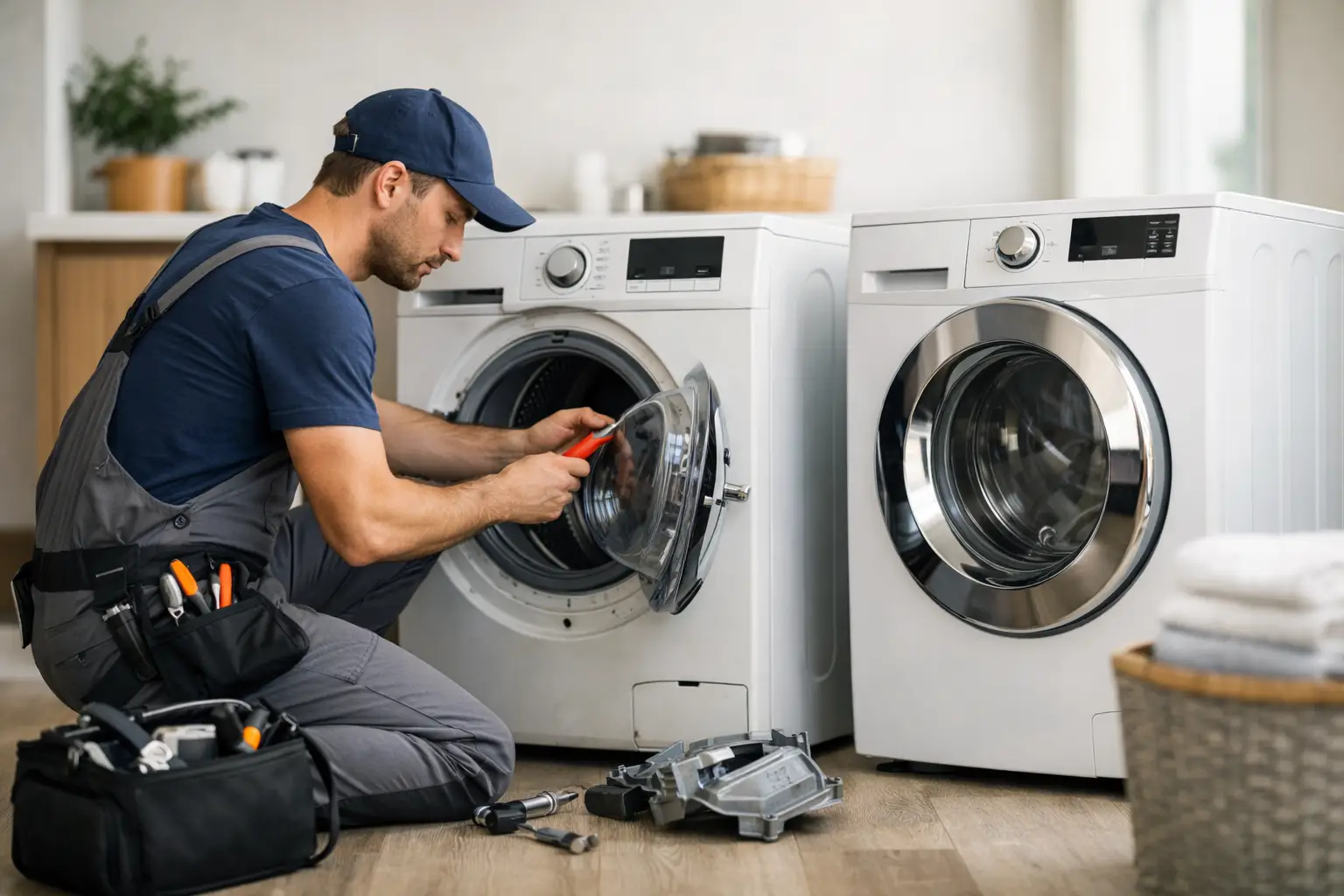
A washing machine usually picks the worst possible time to fail – right before work, right before guests, or right when the laundry is already backed up. When that happens, the real question is not just what broke. It is whether washer repair or replacement is the better financial and practical decision for your home.
For most homeowners, the right answer depends on three things: the machine’s age, the nature of the failure, and how often the problem has been coming back. A washer that needs a straightforward part replacement is very different from a unit with repeated drainage, spin, and control issues. Looking at the full picture helps you avoid spending too much on a machine that is near the end of its useful life, while also avoiding an unnecessary new purchase when a professional repair would solve the problem.
How to judge washer repair or replacement
The biggest mistake homeowners make is focusing only on the current symptom. If the washer will not spin, will not drain, leaks water, makes loud grinding sounds, or stops mid-cycle, that is only part of the decision. What matters just as much is what condition the rest of the machine is in.
A newer washer with one isolated failure is usually a strong repair candidate. If the cabinet is in good shape, the motor and transmission are sound, and the issue is limited to a pump, belt, door latch, suspension component, or control-related part, repair is often the sensible route. In many cases, a trained technician can diagnose the issue quickly and complete the repair without turning it into a drawn-out process.
An older washer with multiple recent problems is different. If you have already paid for service on one issue and another failure appears soon after, replacement starts to make more sense. That does not mean every older washer should be discarded. Some machines are built more durably than others, and some repairs are still cost-effective even on older units. But repeated breakdowns are usually a sign that more wear-related problems are on the way.
Age matters, but not by itself
Most residential washers last around 10 to 13 years, depending on brand, build quality, frequency of use, and maintenance history. A machine used heavily by a large family will naturally wear faster than one in a low-use household.
If your washer is under 5 years old, repair is often the first option worth considering, especially if the problem is mechanical or electrical and the machine has otherwise been reliable. At that stage, replacing the entire unit for one failed component is often unnecessary.
Between 6 and 10 years, the decision becomes more situational. This is where a proper diagnosis matters most. A moderate repair on a washer in this range may still offer good value if the appliance has not had recurring issues. But if the machine has been noisy, unbalanced, slow to drain, or inconsistent for a while, a single repair may not be the end of the story.
Once a washer passes the 10-year mark, replacement becomes more likely if the repair is expensive or the part failure points to broader wear. That said, age alone does not settle it. A well-maintained washer with one repairable issue may still deserve attention, while a newer model with repeated electronic failures may not be worth continued investment.
The cost rule homeowners actually use
Many people have heard some version of the 50 percent rule – if the repair cost approaches half the price of a replacement, it may be time to move on. That rule can be useful, but it is not perfect.
It helps most when you are dealing with a major component failure on an aging machine. If the repair is expensive and the washer is already near the end of its normal lifespan, replacement often provides better long-term value.
But the raw number is not everything. You also have to factor in installation costs, delivery timing, disposal of the old unit, and the inconvenience of shopping for a new washer while laundry piles up. A repair that costs more than you hoped may still be the smarter choice if it restores a newer machine quickly and reliably.
A professional diagnosis is what gives that cost rule meaning. Without it, you are just comparing guesses.
Common washer problems that are often worth repairing
Some washer issues sound serious but are often very repairable. A machine that will not drain may have a failed drain pump or a blockage. A door that will not lock can stop the entire cycle, but the fix may be limited to the latch assembly or related controls. Excessive shaking may come from worn suspension parts rather than a failing tub system.
Water leaks also vary widely in severity. A damaged hose, pump issue, door boot problem, or loose connection may be resolved without replacing the washer. The same goes for certain no-spin conditions, depending on whether the cause is a switch, belt, actuator, or another isolated component.
These are the situations where washer repair often makes strong financial sense, especially when the machine is otherwise in good condition and parts are available.
Signs replacement may be the better move
There are also cases where replacement is the more practical path. One clear sign is when the washer has multiple overlapping issues. If it leaks, struggles to spin, makes loud bearing noise, and intermittently shuts off, that points to broader wear rather than one clean repair.
Another sign is when the needed repair involves a major high-cost component on an older unit. Depending on the model, problems involving the transmission, tub bearings, motor system, or main control can push the economics toward replacement.
Parts availability matters too. Some older washers become harder to service because key components are discontinued or delayed. Even if repair is technically possible, long wait times and uncertain part sourcing can make replacement the more realistic option.
Then there is efficiency and performance. If your current washer has become unreliable, rough on clothes, noisy, or poor at handling normal household loads, replacement may improve both convenience and monthly utility use. That benefit should not be overstated, but it is part of the decision.
Why a professional diagnosis saves money
Homeowners are often forced to make this decision quickly. Laundry disruption adds up fast, especially for families. But moving too fast can be expensive in either direction.
Replacing a washer without a diagnosis may mean getting rid of a machine that needed a manageable repair. On the other hand, approving a major repair without understanding the washer’s overall condition can lead to more spending later.
A trained technician can do more than identify the failed part. They can assess wear, look for related issues, and give you a realistic sense of whether the repair is likely to hold up. That is the difference between fixing a washer and actually solving the problem.
For busy households, this matters as much as the price itself. You need an answer you can trust, not a temporary patch that turns into another service call.
Washer repair or replacement for Orange County homes
In Orange County homes, washers tend to see steady use. Families, professionals, and property owners often need a machine back in service quickly, which makes downtime a real cost. In that situation, speed and accuracy matter. A technician who can diagnose the issue correctly, carry common genuine parts, and complete the repair in as few trips as possible gives you a much clearer path forward.
That is especially true when the problem lands in the gray area – not obviously minor, but not clearly a replacement either. A trustworthy service company should tell you plainly when a washer is worth repairing and when it is smarter to stop putting money into it. That kind of guidance protects your budget and your time.
If your washer has stopped draining, spinning, or finishing cycles, the next step should be a real diagnosis, not guesswork. For homeowners in Irvine and across Orange County, Prostar Appliance Service provides professional washer service backed by experienced technicians, stocked parts, and practical recommendations based on the condition of the machine. You can learn more about local service and recent customer experience through our Google Business Profile.