


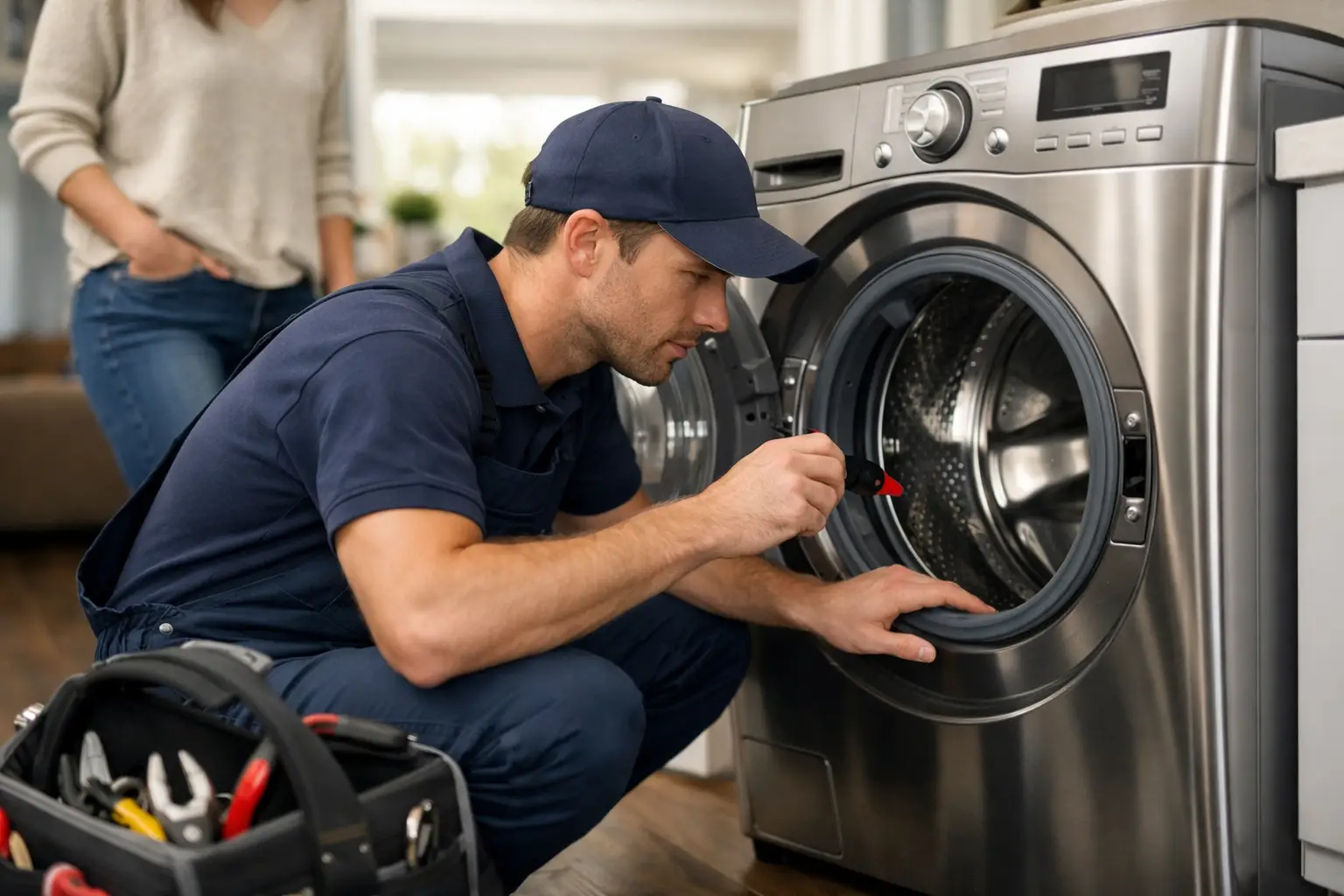
A refrigerator that stops cooling at 8 a.m. is not a problem you want explained in theory. You want to know how fast appliance repair works, whether someone can come out soon, and if the issue can be fixed before groceries, laundry, or dinner plans turn into a bigger disruption.
The short answer is that appliance repair can move very quickly when the service process is set up the right way. Speed usually comes down to three things: how accurately the problem is diagnosed, whether the technician has the right parts, and how many trips the repair takes. For homeowners, that means the difference between a same-day solution and several days of waiting.
How fast appliance repair works from call to completion
Most repairs begin with a service request, but the timeline is often shaped before the technician even arrives. When a customer can clearly describe the symptom – for example, a washer that will not drain, a dryer that heats but does not spin, or an oven that turns on but never reaches temperature – the company can often prepare more effectively for the visit.
That does not mean every problem can be diagnosed over the phone. Appliances fail in different ways, and the same symptom can point to multiple causes. A refrigerator that is warm inside might have a failed compressor relay, a bad thermostat, a control board issue, or restricted airflow. Fast repair depends on narrowing those possibilities quickly once the technician is on site.
In a well-run service call, the technician confirms the complaint, tests the likely failure points, and determines whether the problem is electrical, mechanical, or related to a specific component. If the replacement part is already stocked on the truck or in local inventory, the repair can often be completed in that first visit. That is what most homeowners mean when they ask for fast service – not just a fast appointment, but a fast resolution.
What actually slows appliance repair down
Customers often assume delays happen because repair itself is complicated. Sometimes that is true, but more often the delay comes from logistics.
One common issue is incomplete diagnosis from the start. If a technician replaces a likely part without fully confirming the root cause, the problem may return or remain unresolved. That creates a second appointment that could have been avoided. Fast service is not about rushing through the job. It is about getting the diagnosis right the first time.
Parts availability is another major factor. Many common repairs are straightforward when the part is on hand. A failed igniter in a gas oven, a broken door latch on a dishwasher, or a worn belt in a dryer can often be handled quickly. The timeline changes when the appliance needs a less common board, a brand-specific sensor, or a model-specific sealed system component that has to be ordered.
There is also a difference between accessible repairs and labor-heavy repairs. Replacing a garbage disposal or a microwave fuse is not the same as opening up a built-in refrigerator system or tracing an intermittent electrical fault in a high-end range. Some jobs are naturally faster than others, even with an experienced technician.
Why same-day and next-day service matter
Urgency is not the same for every appliance. If a dishwasher is leaking, timing matters because of potential cabinet or floor damage. If a refrigerator is not cooling, every hour affects food safety and replacement cost. A broken washer or dryer may not create immediate property damage, but it can throw off a household routine very quickly.
That is why scheduling speed matters almost as much as repair speed. A service company that understands appliance urgency treats different calls accordingly. Cooling issues, active leaks, and complete loss of cooking or laundry function usually deserve faster attention than minor performance complaints.
For homeowners in busy households, fast scheduling also reduces the hidden cost of a breakdown. Waiting several days often means replacing food, using a laundromat, ordering takeout, or taking more time off work for follow-up visits. A quick response is not just convenient. It can lower the total impact of the problem.
How trained technicians shorten the repair timeline
Experience speeds up repair in ways customers do not always see. A trained technician can often recognize failure patterns by brand, appliance type, and symptom combination. That does not replace testing, but it makes testing more efficient and more accurate.
For example, a dishwasher that fills but does not wash may be dealing with a circulation motor issue, a control problem, or a float-related interruption. An experienced technician knows which sequence of checks gets to the answer fastest. The same applies to an ice maker that stops producing, a freezer that frosts over, or a dryer that runs without heat.
This matters because fast repair is not about guesswork. It is about reducing wasted motion. A technician who services major brands regularly is more likely to carry the right common parts, use proven diagnostic steps, and avoid unnecessary delays.
Stocked parts make a big difference
If there is one operational factor that has the biggest effect on turnaround time, it is parts readiness. Many household appliance repairs are delayed not because they are hard, but because the needed component is not immediately available.
When service vehicles are stocked with genuine parts for common failures, first-visit completion rates improve. That is especially useful for high-frequency issues such as thermal fuses, igniters, belts, drain pumps, water inlet valves, heating elements, and common sensors. Even when a job cannot be finished the same day, having strong parts access can shorten the delay to the next visit.
There is a trade-off here. Some unusual parts should not be guessed at or pre-ordered without confirming the exact model and diagnosis. Ordering too early can waste time if the wrong part arrives. The fastest repair process balances preparation with accuracy.
How fast appliance repair works for different appliances
Not every appliance follows the same timeline. Washers, dryers, dishwashers, and ranges often allow quicker access to internal components, which can make diagnosis and repair more efficient. Refrigerators and freezers can be more variable because cooling systems involve multiple interdependent parts and, in some cases, longer testing periods.
Microwaves may seem simple, but they require careful handling because of high-voltage components. Ovens and cooktops may involve gas, electrical, or electronic control issues, each with different repair paths. Ice makers can also be deceptively time-consuming because the fault may involve water supply, temperature, fill timing, or control logic rather than the ice maker assembly itself.
That is why a realistic service company does not promise the exact same turnaround on every appliance. The better promise is efficient diagnosis, prompt scheduling, and the fewest trips necessary to complete the repair safely.
What homeowners can do to avoid delays
You do not need to troubleshoot the appliance yourself, but a few details can help move the process along. The model number, brand, age if known, and the exact symptom are all useful. It also helps to note whether the problem is constant or intermittent, whether any error code appears, and whether there are signs of leaking, burning smell, unusual noise, or power loss.
Access matters too. If the refrigerator is built in tightly, if the laundry area is restricted, or if the appliance is stacked, that can affect labor time. None of that prevents repair, but it helps set realistic expectations.
The goal is simple: give the technician enough information to arrive prepared. That makes fast service more likely without turning the customer into the diagnostician.
The real answer: fast means fewer interruptions
When people ask how fast appliance repair works, they are usually asking a broader question: how soon can normal life get back on track? The answer depends on scheduling, diagnosis, parts, and appliance type, but the best repair experience is built around minimizing disruption at every stage.
That means quick response, clear communication, trained technicians, and repair strategies designed to solve the problem in as few visits as possible. It also means being honest when a repair will take longer because of part availability, brand-specific issues, or the complexity of the failure.
If you are dealing with a refrigerator that is not cooling, a washer that will not finish a cycle, or an oven that stopped heating, local experience matters. Prostar Appliance Service helps homeowners across Irvine and Orange County with prompt, professional repair backed by warranty coverage and practical scheduling. You can learn more or get in touch through our Google Business Profile.