


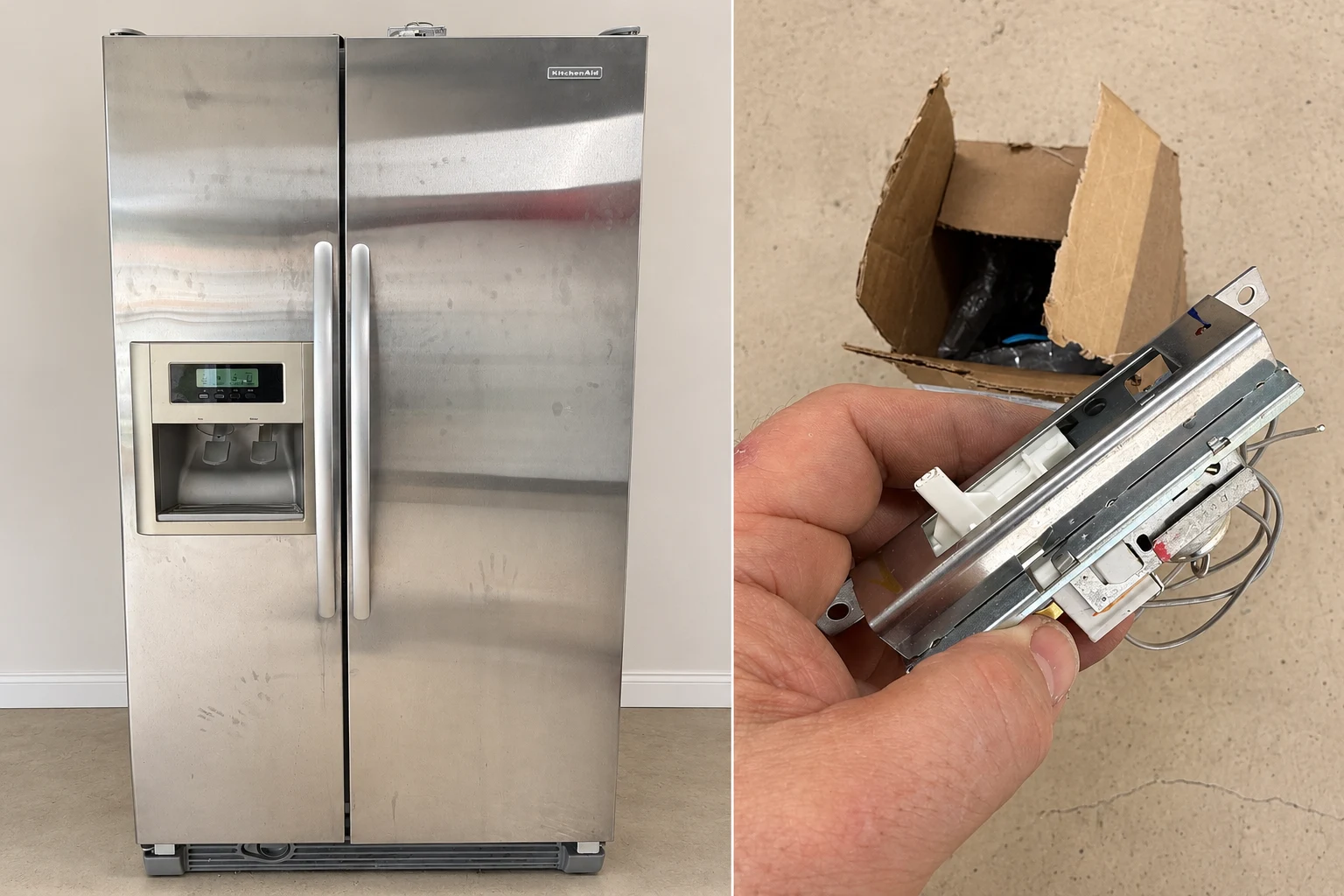
Short answer: on many older KitchenAid refrigerators with a mechanical temperature dial, a failed analog cold-control thermostat can prevent the cooling cycle from starting. The lights may still work, but the compressor and cooling system may never receive the call to run. That is one possible cause—not a diagnosis based on the symptom alone.
We recently found this exact failure during a refrigerator service call in Irvine. The older KitchenAid side-by-side was not cooling at all. After testing the appliance and replacing the failed cold control, normal operation returned. This real repair is a useful example of why an older refrigerator should be diagnosed before anyone assumes that the compressor has failed.
What does an analog cold control do?
The cold control is the refrigerator’s mechanical temperature switch. A sensing tube responds to temperature inside the cabinet, while electrical contacts inside the control open and close the cooling circuit. When cabinet temperature rises, the control should call for cooling. When the selected temperature is reached, it should stop that call.
Unlike newer models that may use thermistors, electronic boards and digital displays, many older refrigerators use a dial connected to this mechanical control. KitchenAid’s own control guidance notes that control styles vary by model and that dial controls use numbered settings. The complete model number and model-specific information therefore matter before parts are selected.
How an older cold-control thermostat can fail
After years of cycling, the internal switch contacts can wear or stop closing reliably. The mechanical sensing system can also lose its ability to respond correctly. Depending on how the control fails, the refrigerator may stop running, operate intermittently, run too long or maintain the wrong temperature.
A cold-control failure is especially easy to misread because the refrigerator can still appear to have power. Interior lights, the dispenser display or other circuits may work normally even though the cooling circuit is not being activated. That is why “the lights are on” does not prove that the refrigerator is actually calling for cooling.
Signs that point toward the cold control
- The refrigerator and freezer become warm while the interior lights still work.
- The compressor and fans remain quiet when the cabinet is clearly too warm.
- Cooling starts or changes after the temperature dial is moved, but the problem returns.
- The refrigerator cycles unpredictably or temperatures vary without a clear door or airflow problem.
- The appliance may become too warm—or, with a different contact failure, run too long and become too cold.
These symptoms are clues only. A bad start device, damaged wiring, failed fan, defrost problem, electronic control or compressor issue can overlap with them. Replacing the thermostat without testing can waste a good part and leave the refrigerator warm.
Cold-control failure versus compressor failure
A failed cold control may keep a healthy compressor from receiving power. A failed compressor may receive the correct call for cooling but still fail to start or pump refrigerant. From the homeowner’s point of view, both conditions can look the same: the refrigerator has power but does not get cold.
A technician separates these possibilities by checking whether the control is calling for cooling, whether proper voltage reaches the start circuit, how the compressor responds and whether fans and the sealed system are operating. The exact test procedure depends on the model and wiring diagram. This is safer and more reliable than guessing from a click, a warm cabinet or the age of the appliance.
Real KitchenAid refrigerator repair in Irvine
During this Irvine service call, the KitchenAid side-by-side refrigerator had stopped cooling completely. Diagnosis identified the analog cold-control thermostat as the failed component. We replaced the control and confirmed that the refrigerator returned to normal operation.
You can see the refrigerator and removed control in the real repair card on our Refrigerator Repair page. The same work is also documented with our other KitchenAid service calls.
What homeowners can safely check first
- Make sure the temperature control was not accidentally moved to Off.
- Confirm that the refrigerator has power and that its circuit breaker is not tripped.
- Keep both doors closed as much as possible and move perishable food if temperatures are rising.
- Listen for normal compressor and fan operation, but do not remove electrical panels.
- Locate the full model number so the correct wiring information and replacement control can be identified.
KitchenAid recommends checking whether cooling is turned on, verifying the control setting and allowing time after a small temperature adjustment. See the manufacturer’s temperature-control guidance for general information, then use the owner’s manual for the specific model.
Is the refrigerator worth repairing?
A failed cold control does not automatically mean an older KitchenAid refrigerator should be replaced. If the cabinet, doors, compressor and sealed system remain in good condition and the correct part is available, this can be a focused repair. The practical decision depends on diagnosis, overall condition, part availability and the repair estimate—not age alone.
Questions about KitchenAid cold controls
What is an analog cold-control thermostat?
It is a mechanical temperature control used in many older refrigerators. Its internal switch calls for cooling as cabinet temperature rises and stops the cooling cycle when the selected temperature is reached.
Can a failed cold control make a KitchenAid refrigerator stop cooling completely?
Yes. If the control does not close its electrical contacts, the refrigerator may have lights but never send the call for cooling. The same symptom can also come from other components, so testing is required.
Does turning the temperature dial prove the thermostat is bad?
No. A refrigerator that starts after the dial is moved provides a useful clue, but it does not confirm the failed part. Wiring, start components and other controls can create similar behavior.
Is it safe to replace a refrigerator cold control yourself?
The control is connected to line-voltage wiring and usually requires panel removal and correct routing of a sensing tube. Homeowners can check settings and power, but internal testing and replacement should be handled safely using model-specific service information.
Is an older KitchenAid refrigerator worth repairing for this problem?
Often it can be, when the cabinet, doors and sealed system are still in good condition and the correct control is available. The decision should follow diagnosis and a clear repair estimate.
For an older KitchenAid refrigerator that is not cooling in Irvine or nearby Orange County, start with a model-specific diagnosis. Learn more about KitchenAid appliance repair or review our full refrigerator repair service.