


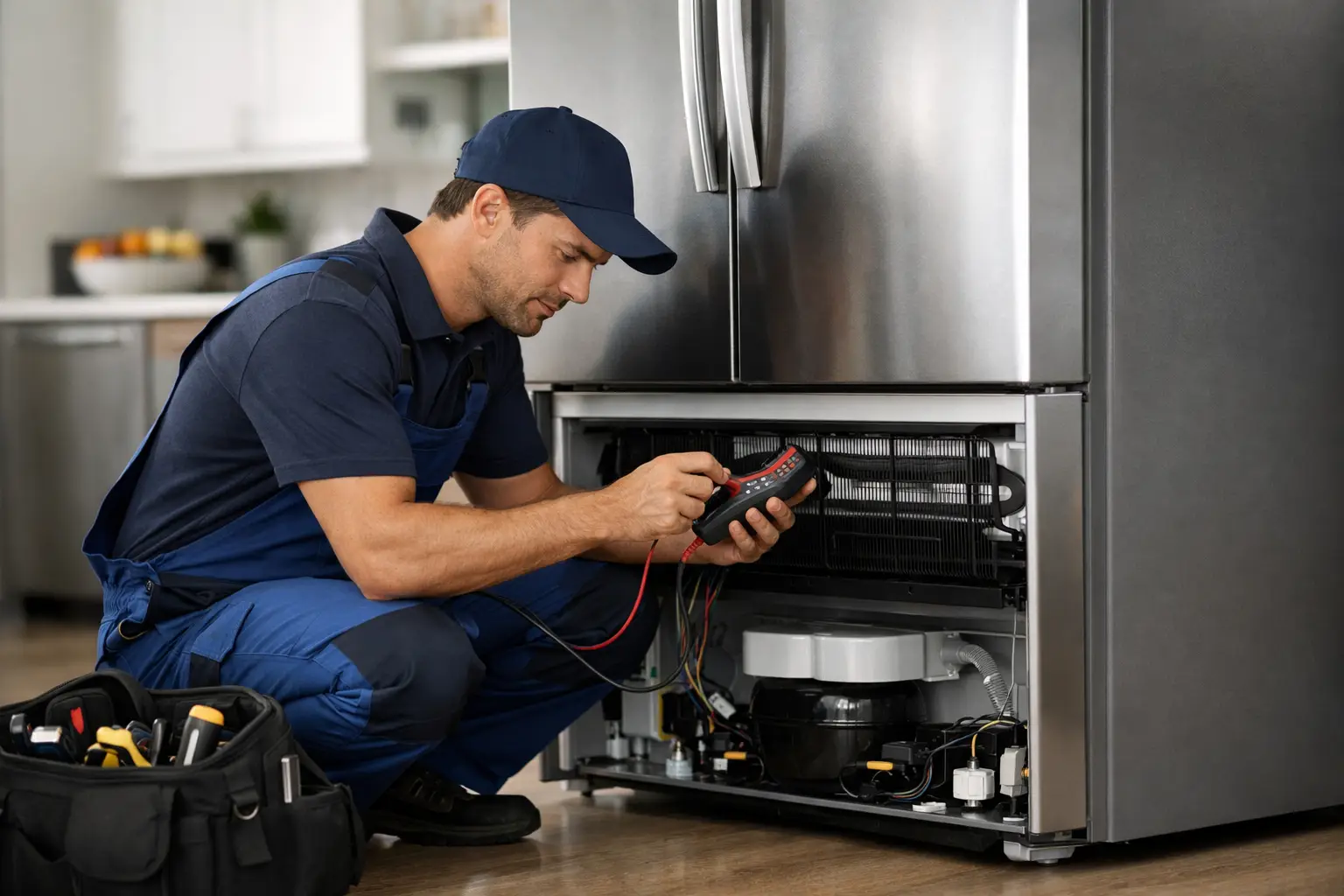
A warm refrigerator is one of those house problems that stops the day cold. Food is at risk, routines get disrupted, and most homeowners want a clear answer fast. If you are wondering how refrigerator repair visits work, the short version is simple: the technician gathers symptoms, inspects the unit, tests key components, explains the issue, and completes the repair if the right part is available.
That sounds straightforward, but the details matter. A good service visit is not just about showing up and swapping a part. It is about narrowing down the real failure, avoiding unnecessary work, and handling the repair in as few trips as possible.
How refrigerator repair visits work from the first call
The process usually starts before the technician ever arrives. When you call or request service, you will likely be asked for the refrigerator brand, model number, and the problem you are seeing. That could be a fridge section that is warm, a freezer that is frosting over, a leaking unit, a noisy fan, or an ice maker that stopped producing ice.
This first step is more important than it may seem. Refrigerators can fail in several different ways that look similar from the outside. A warm fresh-food section might be caused by a failed evaporator fan, a defrost problem, restricted airflow, a bad thermostat, a control board issue, or dirty condenser coils. Good scheduling questions help the technician arrive prepared with likely parts and the right testing approach.
If you can provide accurate symptoms, it helps speed up the visit. That does not mean you need to diagnose anything yourself. It simply means details like whether the freezer is still cold, whether you hear clicking, or whether the leak happens under the crisper drawers can help narrow the possibilities.
What happens during the refrigerator repair visit
Once the technician arrives, the visit usually begins with a short conversation about what the refrigerator has been doing. In many cases, the problem is intermittent, so what happened over the last day or two matters. The technician may ask when the issue started, whether the unit recently lost power, whether doors have been left open, or whether any unusual sounds or odors have been noticed.
From there, the inspection starts. This is where experienced appliance repair matters. Refrigerators involve electrical components, sealed cooling systems, fans, sensors, defrost parts, door gaskets, drains, and control systems. A trained technician does not guess based on one symptom alone. The goal is to verify the failure through testing.
That may include checking temperatures in different compartments, inspecting frost patterns, testing continuity on components, measuring voltage, listening to the compressor and fans, and examining the drain system or condenser area. On some models, the technician may also check error codes or service diagnostics through the control panel.
The length of this stage depends on the problem. A broken door gasket is generally quick to identify. An intermittent cooling issue can take longer because the technician has to rule out more than one possible cause. That is one reason homeowners sometimes feel frustrated by the phrase diagnostic visit. In reality, diagnosis is the part that prevents misdiagnosis, repeat failures, and wasted money.
Why some refrigerator repairs are done in one visit and others are not
Homeowners usually want a same-day fix, and sometimes that is exactly what happens. If the technician confirms a common failure and has the needed genuine part in stock, the repair may be completed during the initial visit. Fan motors, thermostats, inlet valves, ice maker components, switches, and some defrost parts often fall into that category.
But it depends on the refrigerator and the failure. Some units use model-specific parts that are not practical to carry on every truck. Built-in models, newer electronic controls, and certain brand-specific components may need to be ordered after diagnosis. In those cases, the first visit identifies the failed part and the follow-up visit completes the installation.
This is not always a sign of delay or poor planning. Refrigerators vary widely by brand and design, and using the correct part matters. A service company that stocks common genuine parts and works on major brands can reduce repeat trips, but no technician can carry every possible control board, fan assembly, or sealed-system component for every model ever made.
How refrigerator repair visits work when parts are needed
If a part has to be ordered, the technician should explain what failed, what part is required, and what the next step looks like. That clarity makes a big difference. Most homeowners are less frustrated by a second visit than by vague answers.
A professional repair process should give you a practical timeline, not a guess dressed up as certainty. Some parts arrive quickly. Others depend on manufacturer availability. If the refrigerator is still partially cooling, you may be able to keep using it with limitations until the return visit. If it is no longer holding safe temperatures, the technician should tell you plainly.
This is also the point where you may hear whether repair makes financial sense. Not every refrigerator should be repaired. If the unit has a major sealed-system failure, if the repair cost is high compared with replacement value, or if multiple systems are wearing out at once, the honest answer may be that replacement is the better investment. A trustworthy service company does not push a repair that is unlikely to hold up.
What you can expect inside your home
A refrigerator repair visit should be organized and respectful of your home. In most cases, the technician will need access to the appliance, enough space to open doors fully, and sometimes room to pull the refrigerator forward for rear access. If the issue involves water lines, ice makers, or floor leaks, nearby flooring and cabinetry may also need to be checked.
You generally do not need to empty the refrigerator before the technician arrives unless you were specifically told to do so. For many problems, the unit can be inspected as-is. If a deeper internal repair is needed, the technician will let you know what should be removed. It is helpful to clear obvious obstacles around the appliance and secure pets so the visit can move efficiently.
A good technician should also explain findings in plain terms. You should not be left trying to decode technical language. The best service calls are clear about the cause of the problem, the recommended repair, the expected result, and any limitations or risks.
Common refrigerator problems a technician may diagnose
Many service visits involve cooling complaints, but the actual causes vary. A refrigerator that runs constantly may have dirty coils, a weak seal, or a control problem. Water under the drawers may point to a clogged defrost drain. Loud noises may come from an evaporator fan, condenser fan, or compressor area. Ice maker issues can involve water supply problems, frozen fill tubes, failed valves, or bad modules.
This is why symptom-based online advice often falls short. Two refrigerators can show the same outward problem and need completely different repairs. The value of the visit is not just replacing a bad part. It is confirming which part is actually bad.
Timing, cost, and what affects both
Repair timing depends on diagnosis, part availability, and the complexity of the work. Simple mechanical issues can often be handled quickly. Electrical and control-related problems may take longer to confirm. Built-in refrigerators and premium models often require more time due to access, specialized parts, or more involved disassembly.
Cost also depends on the failure, not just the symptom. A refrigerator that is warm because of a fan motor issue is usually a different repair category than one with a compressor or sealed-system problem. Labor, parts, and whether a return visit is needed all affect the final total.
The key is transparency. You should understand what you are paying for and why. Warranty coverage on parts and labor also matters because it reflects confidence in the work. When a company stands behind repairs, that provides more peace of mind than a low quote with unclear follow-through.
How to make the visit go smoothly
The easiest way to help the appointment stay efficient is to have the model number ready, describe the symptoms accurately, and avoid unplugging the unit unless instructed to do so. If the refrigerator has been turning on and off, making noise, leaking, or showing temperature swings, those details are useful. If another company already looked at it, that can be helpful too, especially if parts were previously replaced.
It is also smart to ask practical questions. Is the refrigerator safe to use right now? Is this likely a one-visit repair? Are parts commonly available? Is the repair covered by a labor and parts warranty? Clear answers tell you a lot about the quality of the service.
When homeowners in Irvine and across Orange County need fast, dependable refrigerator service, they usually want the same thing: an accurate diagnosis, a repair that holds up, and as little disruption as possible. If you need help with a refrigerator that is not cooling, leaking, or making unusual noise, you can check our Google Business Profile to connect with a local appliance repair team that values prompt service and reliable workmanship.