


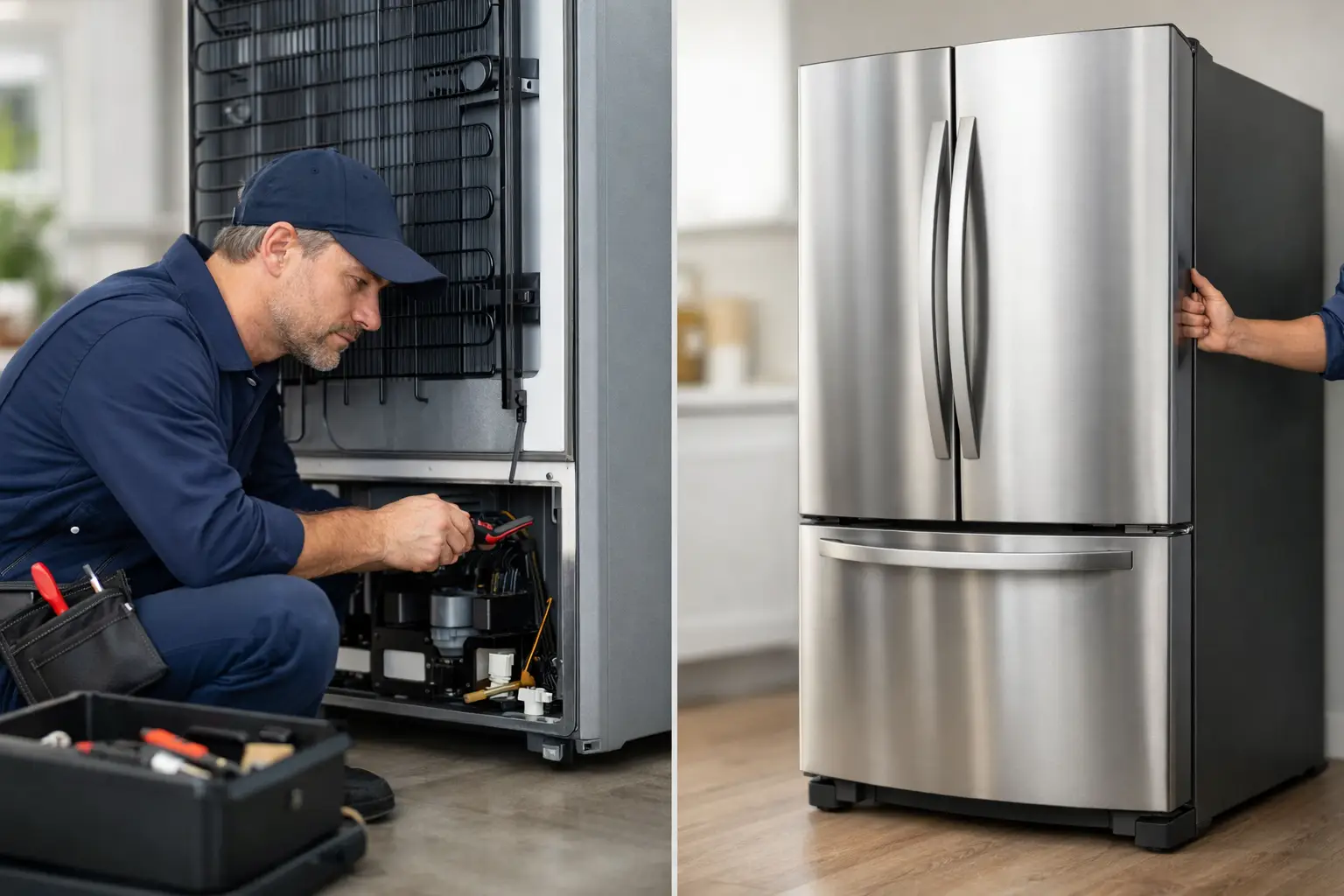
A refrigerator failure can become expensive quickly. Food is at risk, routines are interrupted, and homeowners often feel pressured to buy a new unit before they know what is actually wrong. Refrigerator repair versus replacement is not a one-size-fits-all decision. The right choice depends on the refrigerator’s age, the type of failure, the expected repair cost, and whether the appliance has otherwise been dependable.
For many Orange County households, a professional diagnosis is the fastest way to make a confident decision. A cooling problem may be caused by a replaceable part, not a failed refrigerator. On the other hand, an older unit with major sealed-system trouble may not be worth a substantial investment. Knowing the difference helps you avoid replacing an appliance that can be repaired reliably or spending money on a repair that only delays replacement.
Refrigerator Repair Versus Replacement: Start With the Failure
The first question is not how old the refrigerator is. It is what failed and why. Some common refrigerator problems are usually repairable, including a failed thermostat, faulty start relay, worn door gasket, broken ice maker component, defective fan motor, clogged defrost drain, or damaged water inlet valve. These repairs can restore normal operation without requiring a new refrigerator.
A refrigerator that is not cooling may also have a problem with its condenser fan, evaporator fan, control board, temperature sensor, or defrost system. These issues need proper testing because several parts can produce similar symptoms. Replacing parts based on a guess can waste time and money while leaving the underlying problem unresolved.
More serious concerns include compressor failure, a refrigerant leak, or a sealed-system restriction. These repairs can be more labor-intensive and costly, particularly on an older refrigerator. The exact decision still depends on the brand, model, condition, and availability of genuine replacement parts. A qualified technician should identify the failed component before you compare repair pricing with the cost of a replacement unit.
When Refrigerator Repair Is Usually the Better Choice
Repair is often the practical option when the refrigerator is under 8 to 10 years old, has been reliable, and needs a moderate repair. Many quality refrigerators are built to last well beyond a decade with proper maintenance and timely service. If the cabinet, doors, shelves, seals, and major components are in good condition, a targeted repair can offer strong value.
The cost of the repair matters, but it should be viewed against the real cost of replacement. A new refrigerator may require delivery charges, removal of the old appliance, installation, new water-line connections, trim adjustments, or even cabinet modifications. Counter-depth, built-in, and panel-ready models can be especially expensive to replace. Repairing a well-maintained refrigerator may keep a kitchen functional without disrupting the home or forcing a rushed purchase.
A repair also makes sense when the issue is isolated. For example, an ice maker that stops producing ice does not automatically mean the whole refrigerator has reached the end of its life. The same is true for a leaking water dispenser, a noisy fan, frost buildup in the freezer, or a door that no longer seals correctly. These symptoms can be frustrating, but they often point to serviceable components.
Professional repair is especially valuable when a technician can confirm that the compressor and sealed system are operating properly. Once the most costly systems are ruled out, homeowners can make a repair decision with much more confidence.
Signs a Repair May Be Worth Scheduling Soon
Do not wait too long if the refrigerator is running constantly, temperatures are becoming inconsistent, water is pooling under the unit, or frost is building up where it should not. A minor fault can sometimes create a larger problem if the appliance continues operating under stress. For example, a weak door gasket can make the compressor work harder, while a defrost problem can eventually restrict airflow and reduce cooling.
Addressing a problem early can also protect food and prevent a complete breakdown at the worst possible time. When a refrigerator is still cooling but showing warning signs, diagnosis and repair are often less disruptive than waiting until it stops entirely.
When Replacing the Refrigerator May Make More Sense
Replacement becomes more reasonable when an older refrigerator needs a major repair and has other signs of decline. Frequent service calls, recurring cooling problems, excessive noise, rust, cracked liners, failing door hinges, or repeated ice maker failures can indicate that the appliance is nearing the end of its useful service life.
Age is a useful guideline, not an automatic rule. A basic top-freezer refrigerator that is 12 years old may still be worth repairing if it has a limited, affordable problem. A high-end French-door or built-in refrigerator may also justify repair at an older age because replacement costs are much higher. Conversely, a lower-cost refrigerator with a major compressor or sealed-system failure may be difficult to justify repairing once it is well past its expected lifespan.
Energy use is another consideration, although it should not be the only reason to replace a working appliance. Newer models may offer improved efficiency, but the savings on utility bills may not offset the immediate cost of a new refrigerator for many years. If the current unit is cooling correctly after a reasonable repair, repairing it can still be the more cost-conscious choice.
Replacement may be the better path when the needed parts are no longer available or when the repair cost approaches a significant portion of the price of a comparable new model. In that situation, a technician’s diagnosis still has value. It gives you a clear reason for the failure and helps you avoid replacing the refrigerator based only on symptoms.
Use the Repair Cost Rule Carefully
Homeowners sometimes hear that they should replace a refrigerator if the repair costs more than half the price of a new one. This rule can be useful as a starting point, but it is not always accurate. The price of a new refrigerator varies widely, and a comparable replacement may cost far more than an entry-level model.
Instead, consider four questions together: How old is the refrigerator? What is the exact repair? Has it needed frequent repairs? What would a comparable replacement cost after delivery and installation? A $400 repair on a dependable eight-year-old refrigerator may be sensible. The same repair on a 16-year-old unit with recurring cooling issues may not be.
It is also wise to consider your household’s immediate needs. Families who depend on a large refrigerator for meal prep, specialty diets, medications, or frequent entertaining may value a repair that gets the unit operating quickly. A replacement decision can involve shopping, delivery windows, installation coordination, and moving food to temporary storage.
Why an Accurate Diagnosis Protects Your Budget
The biggest mistake in this decision is treating every cooling issue as a compressor failure. Modern refrigerators use multiple sensors, fans, controls, and defrost components. A refrigerator can appear completely dead when a smaller electrical or airflow-related part is responsible.
An experienced technician checks temperatures, airflow, compressor operation, electrical connections, error codes, frost patterns, and component readings before recommending the next step. That process separates a practical repair from a major system problem. It also helps ensure that any replacement part is the correct part for the model.
At Prostar Appliance Service, trained technicians work to identify the cause of the problem, not just the visible symptom. Genuine parts, when available, and warranty-backed workmanship can make a repair a dependable solution rather than a short-term patch.
Keep Your Refrigerator Decision Focused on Value
The best refrigerator decision is rarely based on age alone or the first price you hear. A newer refrigerator with a failed fan motor should not be replaced unnecessarily. An aging unit with a costly sealed-system issue and a history of breakdowns should not receive endless repairs. The goal is dependable cooling, reasonable cost, and the least disruption for your household.
For homeowners in Irvine and nearby Orange County communities, prompt professional diagnosis can clarify whether a repair is the practical choice or whether replacement is the smarter long-term move. If your refrigerator is warming up, leaking, making unusual noises, or failing to make ice, arranging service early can help protect your food and give you a clear path forward.