


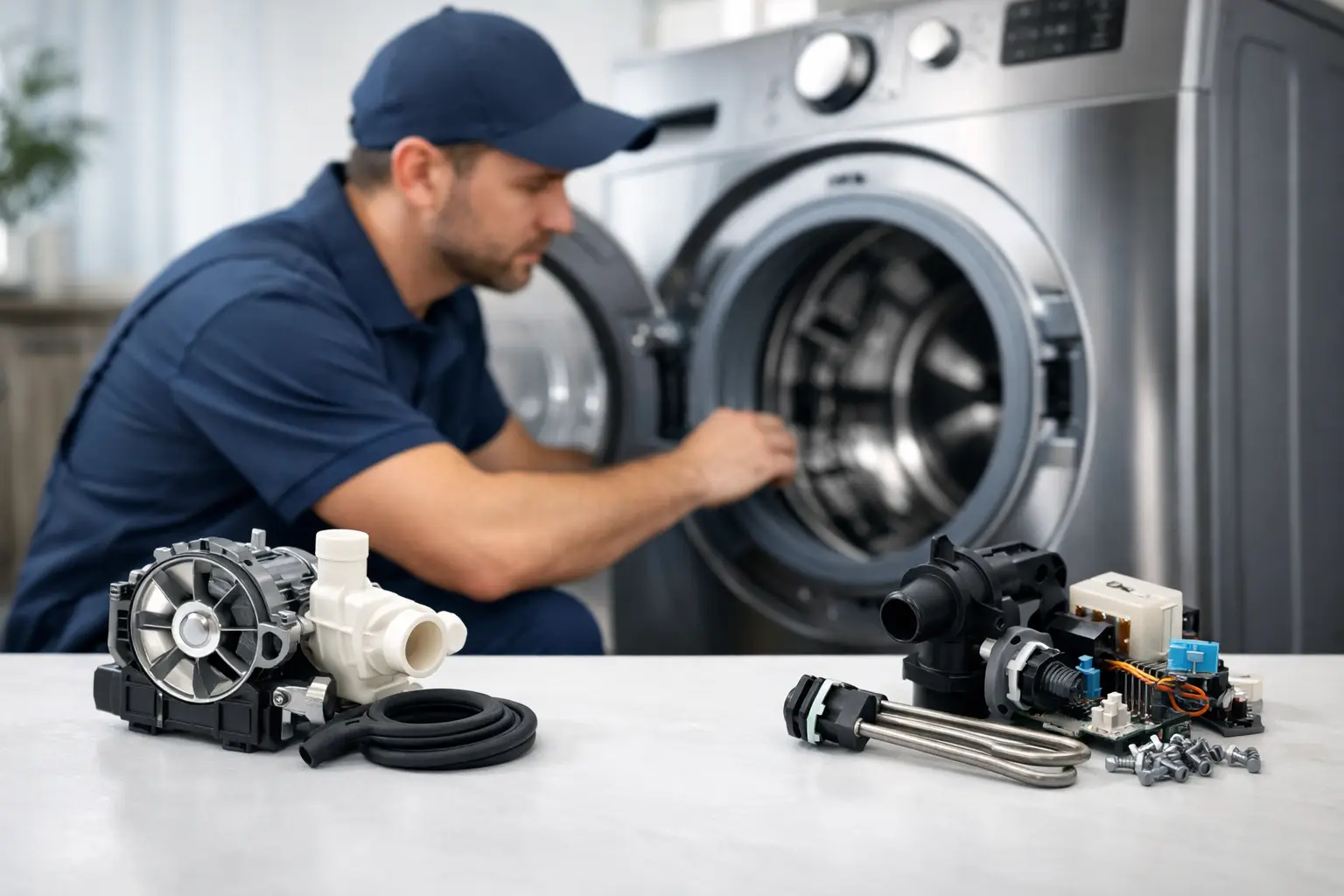
A refrigerator that will not cool, a washer that stops mid-cycle, or an oven that will not heat creates one immediate question: can it be repaired correctly without spending more than necessary? When comparing genuine parts vs aftermarket parts, the right answer depends on the appliance, the failed component, and the repair’s long-term value – not simply the lowest price on a part.
For a busy Orange County household, the goal is usually clear: restore the appliance quickly, safely, and with as little chance of another breakdown as possible. The replacement part chosen during a repair can make a real difference in how well that happens.
What Are Genuine Appliance Parts?
Genuine parts, often called OEM parts, are made by or for the appliance manufacturer. They are designed for a specific brand and model, using the manufacturer’s measurements, materials, and performance specifications.
If a dishwasher needs a new circulation pump or a refrigerator needs a control board, a genuine replacement part is intended to match the original component that came with the machine. This does not mean every OEM part is made in the same factory as the original, but it does mean the manufacturer has approved it for that appliance model.
For many repairs, that fit and compatibility matter more than homeowners realize. Modern appliances rely on sensors, electronic controls, water valves, motors, and safety components that must communicate and operate within exact ranges. A part that looks similar is not always an equal replacement.
What Are Aftermarket Appliance Parts?
Aftermarket parts are produced by companies other than the original appliance manufacturer. Some are made as direct replacements for specific models. Others are universal components intended to fit several brands or appliance types.
The quality of aftermarket parts varies widely. A well-made aftermarket igniter, belt, or door switch may perform well and offer a practical repair option. On the other hand, lower-grade parts can have inconsistent dimensions, weaker materials, or electrical specifications that do not match the appliance’s requirements.
That variation is the central issue. Aftermarket does not automatically mean poor quality, just as genuine does not automatically mean the only reasonable choice. The technician must determine whether the specific replacement is dependable for the repair at hand.
Genuine Parts vs Aftermarket Parts: The Key Differences
The most visible difference is usually cost. Aftermarket parts can cost less because they are produced without the manufacturer’s branding, distribution system, or model-specific approval process. For a simple mechanical component, that lower upfront cost may be appealing.
However, the initial part price is only one part of the repair decision. A replacement that fails early can create another service appointment, another disruption, and potentially additional labor charges. A less expensive part is not a savings if it leads to repeat repairs within a short period.
Fit and compatibility
Genuine parts are designed to fit the appliance model they are listed for. This is especially valuable for components such as control boards, user interfaces, ice maker assemblies, refrigerator sensors, drain pumps, and sealed-system-related parts.
Aftermarket components may fit physically while operating differently once installed. A sensor may read temperatures inaccurately. A water valve may have the wrong flow characteristics. A control board may not communicate correctly with the appliance’s wiring or software. These issues can be difficult to identify until after the repair is complete.
Reliability and service life
An OEM part is generally the safer choice when reliability is the priority, particularly for frequently used appliances. A family’s refrigerator, dishwasher, washer, and dryer often run several times a week. Components in these machines work under heat, moisture, vibration, and electrical load.
Quality aftermarket parts can be suitable for certain repairs, but the expected service life is less predictable across brands and suppliers. For homeowners who plan to keep an appliance for years, a genuine part may provide better value even when it costs more initially.
Safety considerations
Safety-related parts should not be treated as a place to cut corners. Oven igniters, gas valves, thermal fuses, door locks, dryer heating components, electrical harnesses, and microwave parts need the correct ratings and secure fit.
A part that is not designed for the appliance can create performance problems, cause error codes, or contribute to unsafe operation. A trained technician can verify whether the part is approved for the model and whether the appliance is safe to return to service after the repair.
Warranty protection
Part and labor warranties matter because they show who stands behind the completed repair. Genuine parts may carry manufacturer-backed coverage, while aftermarket part warranties vary by supplier. In some cases, the part may be covered but the labor to replace it again may not be.
Always ask what warranty applies to both the replacement part and the repair work. A clear warranty gives homeowners a better way to compare repair options than price alone.
When an Aftermarket Part Can Make Sense
There are situations where a quality aftermarket part is a reasonable option. Common mechanical items, such as certain dryer belts, rollers, hoses, filters, or basic switches, may be available from reputable manufacturers at a lower cost. If the appliance is older and the repair budget is limited, an aftermarket option can help extend its useful life.
The decision should still account for the appliance’s overall condition. If a 12-year-old dryer needs a belt, spending less on a dependable replacement belt may be sensible. If that same dryer needs a costly control board and has several other worn components, it may be time to compare the repair cost with replacement.
Aftermarket parts are also sometimes the only option when an original part has been discontinued. In that case, an experienced technician should identify a proven compatible alternative rather than installing a generic part based only on appearance.
When Genuine Parts Are Usually Worth It
Genuine parts are often the stronger choice for electronic, model-specific, or safety-critical repairs. That includes refrigerator control boards, inverter boards, electronic displays, compressor-related components, dishwasher pumps, oven control systems, and factory-designed ice maker assemblies.
They are also a good choice when the appliance is newer, still under manufacturer warranty, or part of a premium kitchen or laundry setup. The cost of the correct part is often small compared with the inconvenience of repeated failures, spoiled groceries, water damage, or a second interruption to your routine.
A genuine part can also reduce uncertainty. Instead of trying to determine whether a compatible substitute will perform correctly, the repair is based on the component specified for that exact appliance model.
Do Not Choose a Part Based on Price Alone
Online listings can make appliance parts appear straightforward: search a model number, find a lower-priced item, and order it. In practice, model numbers frequently have series variations, production changes, and parts that look identical but use different connectors or electrical specifications.
Installing the wrong part can damage the appliance, fail to solve the original problem, or mask a different issue. For example, a refrigerator that is not cooling may have a failed fan motor, a defrost issue, a sensor problem, a control-board fault, or a sealed-system concern. Replacing one inexpensive part without proper diagnosis may not restore cooling at all.
Professional diagnosis identifies the cause before a replacement part is selected. It also helps determine whether investing in a genuine component, using a qualified aftermarket alternative, or considering appliance replacement is the most practical path.
Ask These Questions Before Approving a Repair
Before approving an appliance repair, ask whether the proposed part is genuine or aftermarket, whether it is specifically compatible with your model, and what warranty covers the part and labor. You should also ask whether the appliance has other signs of wear that could affect the value of the repair.
A dependable service company should explain the recommendation in plain language. The goal is not to push the most expensive part. It is to select a repair that fits the appliance’s condition, the household’s needs, and the expected reliability of the result.
When a major appliance disrupts your home, prompt diagnosis and the right replacement part can prevent a small failure from becoming a longer, more expensive problem. Prostar Appliance Service helps homeowners in Irvine and throughout Orange County make informed repair decisions with professional diagnostics, quality parts, and warranty-backed workmanship.